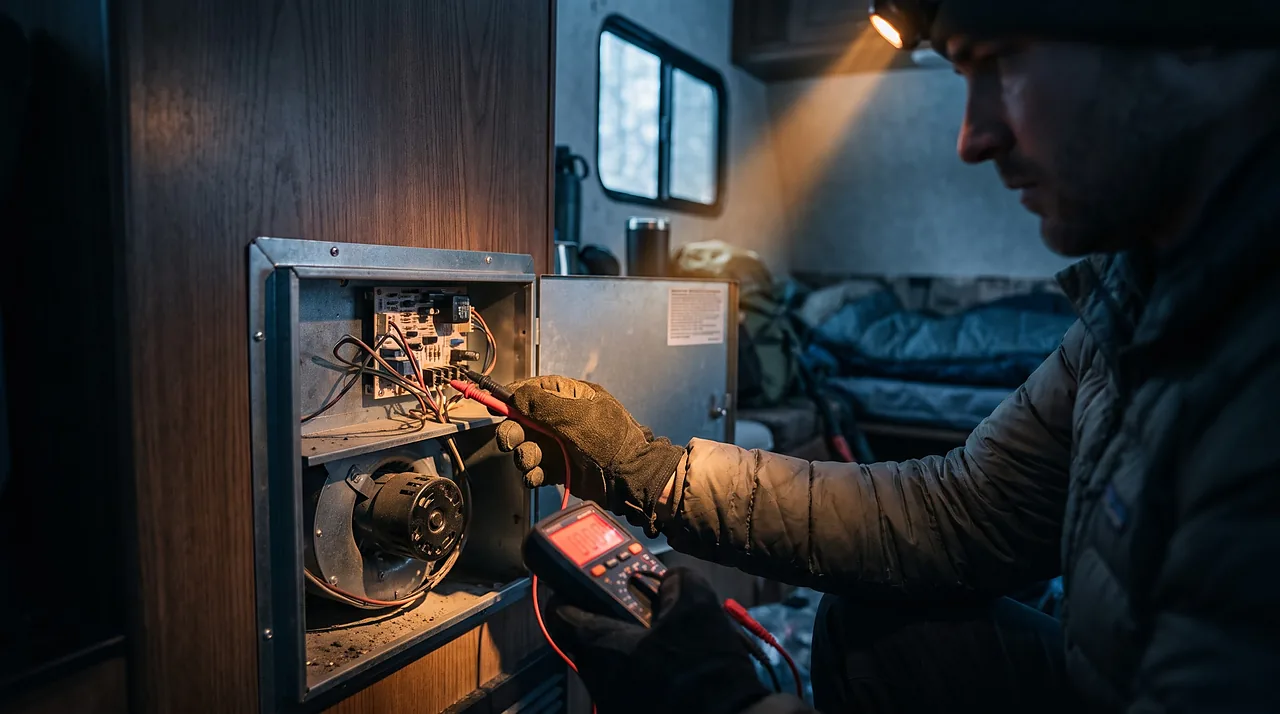
It's 40 degrees outside, the thermostat is calling for heat, and all the furnace gives back is a fast string of clicks and cold air. That clicking is almost always the igniter trying and failing to catch, and the propane tank is often not the problem at all. The three most common causes, checked in the order that actually saves you time, are a battery sitting below about 10.5 volts, a sail switch that never closes because the blower can't move enough air, and a wasp or mud dauber nest packed into the combustion air intake or exhaust vent.
Start with the battery
An RV furnace is a 12-volt DC appliance before it is a propane appliance. Suburban's own service specification for its SF-series furnaces sets the operating window at a minimum of 10.5 volts DC and a maximum of 13.5 volts DC. Drop below that floor and the board protects itself: on two-stage boards specifically, the manufacturer's manual notes the module "constantly checks for a minimum 9.5 volts," and if it doesn't see that, "the module board will go into a stand by mode until adequate power is supplied," resuming on its own once voltage climbs back up. Dometic (formerly Atwood) furnaces follow the same chain of voltage, sail switch and ignition lockout; their exact numbers are in that brand's manual.
What that means at the campsite: a battery bank that reads 12.4 volts on a cheap tester while nothing is running can sag hard the instant the blower motor and igniter draw current. The number that matters is voltage measured under load, right at the furnace, while the blower and igniter are actually drawing current. A weak or old battery, or a battery that's been running the fridge and lights all day without shore power or a working converter, is often the entire problem even though every propane component downstream is perfectly healthy.
Two practical notes from the same manual. First, never power or test the furnace off a plain battery charger; chargers can put out over 14.5 volts DC, and that can damage the module board rather than help it. Second, if your batteries keep sagging toward that 10.5-volt floor overnight even after a full day of driving or shore power, the fault is usually upstream of the furnace entirely, in a converter that has stopped topping off the house battery, and that's worth chasing before you touch a single furnace part.
Then check the sail switch and the airflow feeding it
If voltage tests fine at the furnace with the blower running, the next stop is the sail switch. It's a small paddle-and-microswitch assembly sitting in the airflow path, and its only job, in the manufacturer's own words, is to prove there's adequate air for combustion before the board will open the gas valve: "as the room air wheel comes up to speed, air flow closes the sail switch completing the circuit." No airflow, no closed switch, no gas.

Here's the part owners usually get backwards: a bad sail switch is less common than a good sail switch that simply never sees enough air to close. The blower has to reach speed and the ducting has to allow enough return air, or the paddle never moves. The same manual is specific that dust and lint are enough to cause this on their own: a "build up of dust and lint on the blower wheel can cause the motor to drag and not generate enough air flow to engage the sail switch," and dust sitting directly on the switch "will restrict the travel of the actuator arm and prevent operation of the valve circuit." A shop vac on the blower wheel and a soft brush on the switch arm solves more furnace calls than a $20 replacement switch does. That pattern, a blower that runs steadily while the furnace blows cold, usually stalls right here at the sail switch or the nearby limit switch rather than at the gas valve.
On the electrical side, the board gives this fault a hard clock: if the sail switch circuit stays open for 30 seconds after the blower kicks on, the board locks itself out and shuts the blower down once that timer expires, since a switch that hasn't closed by then isn't going to close on its own.
How to tell a sail switch fault from a lockout
- Blower runs, you hear one or two clicks, then everything stops within about 30 seconds: sail switch circuit never closed.
- Blower runs, igniter sparks for roughly 7 seconds per attempt, repeats twice more, then the blower runs on its own for a few minutes before shutting off entirely: that's the 3-strike ignition lockout, and airflow already proved itself, so look at gas delivery or the electrode instead.
- Nothing happens at all, not even the blower: check the 12-volt fuse feeding the furnace and the thermostat wiring before assuming a board failure.
Last stop before the gas valve: wasps, mud daubers, and blocked vents
Propane has a faint odor that, for reasons no one loves, mud daubers and other wasps find attractive around exterior vent openings. They pack mud and debris into the combustion air intake or the exhaust outlet on the sidewall, and Suburban's manual lists this by name as an expected, recurring restriction: "restriction in the vent or furnace intake (screens, wasp nests, tape)" is a standalone line item in the manufacturer's own trouble-shooting guide, right alongside a dedicated checkpoint to "check for restriction in combustion air intake (wasps, insects, etc.)" before a technician is told to condemn the gas valve.


That's exactly why this check comes third, after voltage and the sail switch: a nest small enough to choke combustion air doesn't necessarily choke the blower enough to trip the sail switch fault first. You can have adequate airflow to satisfy the switch and still have a burner that won't hold a clean flame because the exhaust side is partially packed. Pull the exterior vent cover (a couple of screws, no tools beyond a screwdriver on most units) and look for mud tubes, dead insects, or a mouse nest in the outside air passage before you do anything else at this stage.
Take blocked vents seriously beyond the ignition problem itself. An obstruction anywhere in the vent or main burner path cuts down combustion air, and that produces incomplete combustion, whose byproducts are carbon monoxide and soot. If you ever see black soot forming at the exhaust vent, the guidance is direct: don't run the furnace again until the restriction is found and cleared. Keep a working carbon monoxide alarm in the RV regardless of how the furnace is behaving; a furnace that won't light at all is loud and obvious, one that lights but vents poorly is not.
The order that actually saves a cold night
Work through these five checks in this order. Each one names what you're testing, the manufacturer's number or note behind it, the tell-tale sign it's your problem, and what to do about it.
1. Battery/converter voltage at the furnace, blower running
What you're testing: DC supply under load, read at the furnace while it runs.
Manufacturer's number: minimum 10.5V DC, max 13.5V DC (two-stage board standby floor: 9.5V).
Sign this is your problem: weak clicking, blower sounds slow, furnace works fine on shore power but not on battery.
What to do: test at the furnace terminals with a meter while it's calling for heat; charge the battery or fix the converter.
2. Sail switch and the airflow reaching it
What you're testing: blower speed, duct restriction, dust on the switch arm.
Manufacturer's number: the circuit must close before a 30-second lockout timer expires.
Sign this is your problem: blower runs, a click or two, then everything stops around 30 seconds.
What to do: clean the blower wheel and switch arm; confirm return-air grilles aren't blocked by storage.
3. Combustion air intake and exhaust vent
What you're testing: physical restriction outside on the sidewall.
Manufacturer's number: a named checkpoint covering "wasps, insects" and "screens, wasp nests, tape."
Sign this is your problem: weak or lazy flame, soot at the exhaust, buzzing or rattling at the vent.
What to do: remove the exterior vent cover, clear nests and debris, install an insect screen designed for that vent as part of keeping insects and rodents out.
4. Ignition lockout state
What you're testing: whether the board already gave up after three tries.
Manufacturer's number: three failed trial-for-ignition cycles trigger a lockout, cleared by cycling the thermostat.
Sign this is your problem: furnace ran fine yesterday, today it just sits there or the blower runs without sparking.
What to do: turn the thermostat fully off, wait, then back to heat to reset the board.
5. Propane supply itself
What you're testing: tank level, regulator, a bled line after a fresh cylinder.
Manufacturer's number: outside the furnace's electrical circuit entirely.
Sign this is your problem: voltage is good, the switch is clean, vents are clear, and it still won't hold a flame.
What to do: stop diagnosing the furnace and work through the propane system itself, starting at the regulator and tank valve.
When to stop and call a technician
Cleaning a blower wheel or clearing a wasp nest from an exterior vent is reasonable owner-level work. Opening the furnace chamber, adjusting the electrode gap, or replacing the module board calls for the correct service tools and a technician who does this daily; it is not something to improvise at a campsite. If you smell propane at any point in this process, stop immediately, don't operate any switch or appliance, and get the RV to fresh air before troubleshooting anything else.
Questions
What owners ask next
Why does my furnace click over and over but never actually light?
Repeated clicking with no flame usually means the igniter is sparking but either the sail switch never closed (no proven airflow) or the board hit its three-try ignition limit and stopped sending gas. Check battery voltage first, since a weak supply causes both symptoms.
Can a weak battery really stop the furnace even though the propane tank is full?
Yes. The furnace is a 12-volt DC appliance first. Suburban's own spec sets a 10.5-volt DC minimum for the SF-series to run correctly, and voltage that sags under load can stop the blower and igniter long before propane becomes the issue.
How do I know if my furnace is in lockout instead of just not getting gas?
Lockout typically follows three failed ignition attempts: you'll hear the igniter spark a few times, then the blower keeps running alone for a few minutes before everything shuts off. Cycling the thermostat fully off and back to heat resets the board.
Where exactly do mud daubers and wasps build nests on a furnace?
In the exterior vent assembly on the RV's sidewall, either the combustion air intake or the exhaust outlet, both of which sit close together. Propane's faint odor at ignition seems to draw them, and the manufacturer's own troubleshooting guide lists wasp nests as a named cause of restriction.
What voltage should I actually see at the furnace when it's running?
Suburban's SF-series spec calls for 10.5 to 13.5 volts DC at the furnace. Test it at the furnace wiring while the blower and igniter are active, since that's when voltage sag actually shows up.
Voltage tests fine, the sail switch closes, and it still won't hold a flame, twice in a row. What's left?
At this point the electrical safety chain has already proven itself, so stop retesting it and look downstream of the board instead. The two most likely culprits are the igniter electrode itself (a hairline crack in the ceramic, or a gap that's drifted out of spec, can produce a weak spark that doesn't survive contact with gas) and the gas side proper, a partially open regulator, a kinked line, or air still in the line after a fresh propane fill. A furnace that lights, runs briefly, then drops out on repeat trials rather than failing to spark at all usually points to gas delivery rather than ignition, and that's technician-level work rather than something to keep re-cycling the thermostat over.
Is there a reset button on an RV furnace?
Most RV furnaces have no reset button; the reset is turning the thermostat off, waiting a moment and turning it back to heat, which clears an ignition lockout. If that does not work, switching off the furnace's 12V fuse or breaker at the 12V fuse panel for a minute restarts the board.
The furnace will not kick on at all. Where do I start?
Check that the thermostat is set to heat and above the room temperature, that its batteries (if it has any) are good, that the furnace's 12V fuse is intact, and that the house battery is charged; no blower at all is an electrical problem, not a gas problem.
Read next
Keep going on this system
Sources
What this guide is based on
- Suburban Manufacturing (Airxcel) - RV Furnaces Service & Training Manual
- Dinosaur Electronics - Ignitor Board specifications
- Trojan Battery Company - FAQs
Built from manufacturer manuals and published specifications. If something here does not match your appliance label or manual, the label and manual win.