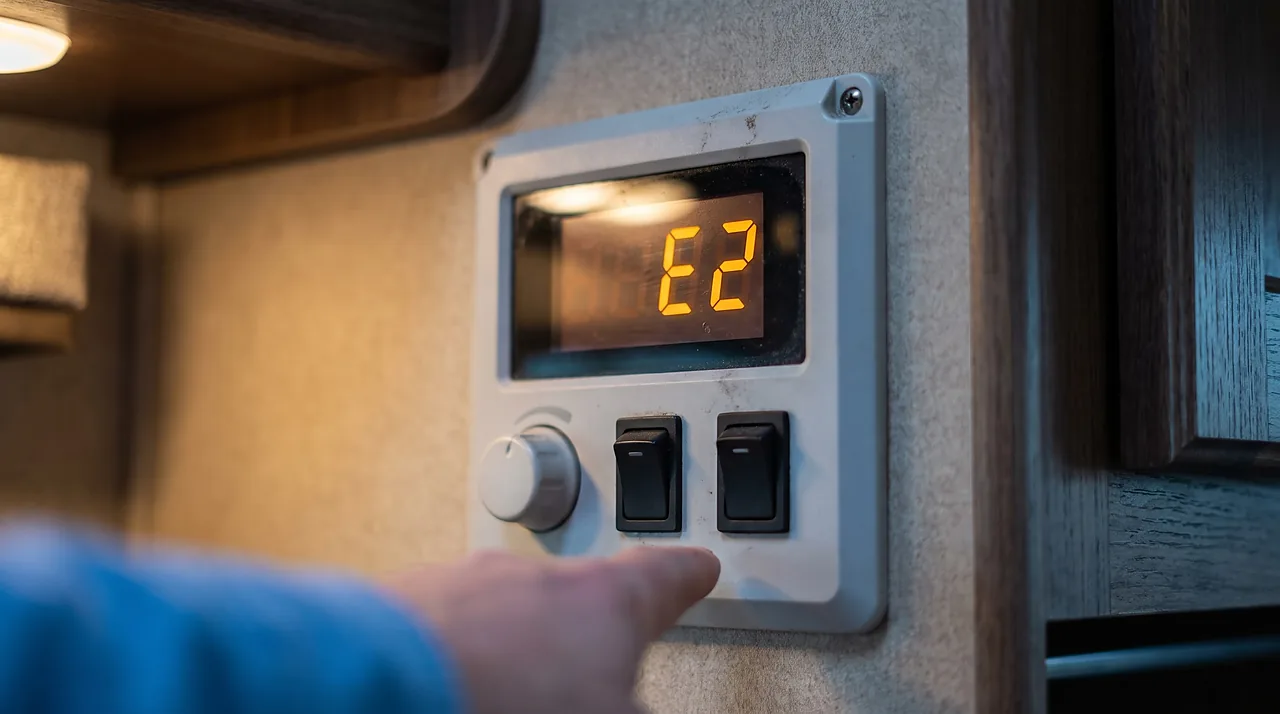
Two letters on a dim control panel, the manual buried somewhere in a storage bin at home, and a campground with one bar of signal. That is the moment this page exists for. The good news: the major RV appliance makers do publish their fault codes and reset steps, in service manuals and support pages, not folklore. This page collects the codes that actually show up on RV fridges, tankless water heaters, and furnaces, names where each one came from, and sends you to the article that walks through the actual repair.
What a fault code actually tells you (and what it does not)
A fault code is a symptom report, not a diagnosis. The control board on a Dometic fridge or a Furrion water heater is watching a handful of sensors (voltage, flame presence, door position, exhaust temperature) and it throws a code when one of them crosses a threshold. That is useful information, but it rarely names the broken part. Code 05 on a Dometic RUA fridge just means the board saw AC voltage drop too low; the actual cause could be a bad campground pedestal, a loose shore cord connection, or nothing at all if you were briefly on a small inverter generator.
Two more things worth knowing before you start clearing codes. First, plenty of RV appliances have no digital fault codes at all. Older two-way absorption fridges with an analog thermostat knob, and most Suburban and Atwood furnaces, communicate through a flame indicator light or a flowchart-based test procedure, not an alphanumeric display. If your appliance is not showing a code, that is normal for its design, not a sign the electronics failed. Second, a code that clears with a reset and then comes right back is not fixed, it is postponed. Repeated resets on the same fault usually make the underlying problem worse (a weak cooling unit, a marginal gas valve, a dying sensor), so treat two resets in a row as your cue to move to the actual diagnostic article for that appliance.
Dometic absorption refrigerator codes (RUA and similar digital-display models)
Dometic's own operating manual for the RUA5208X, RUA6408X, and RUA8408X refrigerators lists a "Faults and beeps" table, and Dometic's support site mirrors the same codes individually. The table below is that list, condensed.

| Code | Type | What it means | First move |
|---|---|---|---|
| 01 | Warning | Thermostat sensor error. Cooling continues on a 45-minute on, 15-minute off cycle while faulted. | Check the thermostat probe is seated against the cooling fins; often clears itself. |
| 03 | Error | No communication between the power module and the display panel. Operation holds at the last known settings. | Reseat the display cable connector; if it repeats, the module or wiring harness needs testing. |
| 05 | Warning | AC voltage too low. | Test the shore power or campground pedestal voltage before assuming the fridge is at fault. |
| 06 | Warning | DC relay not connected. | Check the 12V wiring and fuse feeding the fridge control board. |
| 07 | Error | No performance on gas. Cooling function stops. | Check propane supply and burner ignition; this is the code that routes straight to a full cooling diagnosis. |
| 08 | Error | No performance on AC. Cooling function stops. | Confirm 120V is actually reaching the element, then treat as a cooling-unit issue. |
| 09 | Error | No performance on DC. Cooling function stops. | Same as above, on the 12V side; common while towing if the DC feed is interrupted. |
| 10 | Warning | Door open for more than 2 minutes. | Close the door; the alarm and code clear on their own. |
| 11 | Warning | DC voltage over 16V. | Check the converter or charging system for overcharging. |
Dometic's reset instruction is the same across the error-type codes: press and hold the control knob (or encoder button, depending on model year) for roughly 2 to 4 seconds until it beeps. Hold it too long and you shut the fridge off instead of clearing the fault, which is a common frustration owners report. Warning-type codes (01, 05, 06, 10, 11) clear on their own once the condition that triggered them goes away; they do not need the manual reset at all.
If the fridge cools on gas but not on electric, code 08 (no performance on AC) is the one to look for; the electric branch of the fridge guide covers the fuse, the pedestal and the heating element.
If your fridge is genuinely not getting cold rather than just flashing a code, this table is only the starting point. For the level check, the vent-fan airflow, and the actual cooling-unit failure modes, the full walkthrough is in the guide to a Dometic or Norcold fridge that will not cool. And if your unit predates the digital display entirely (a two-way absorption fridge with a simple analog thermostat and a flame-check window instead of a screen), there is no code to look up: you are working from symptoms, which that same guide also covers. Norcold digital fridges use their own code list, printed in the Norcold manual; the table above is Dometic only.
Tankless water heater codes (Furrion and similar)
Furrion's own user manual for its on-demand gas water heaters (the FWH09A-AM series) lists eight codes, E0 through E7. A few of them are owner-fixable; several are explicitly "system fault, contact Furrion" with no field remedy listed.

| Code | Sensor | Meaning | Listed action |
|---|---|---|---|
| E0 | Water outlet temperature | System fault | Contact Furrion |
| E1 | Flame sense during ignition | Insufficient fuel supply to start | Confirm gas valves open and tanks have fuel; check regulator |
| E2 | Flame signal detection | Low gas inlet pressure | Check the regulator, replace if needed |
| E3 | Over-temperature mechanical sensor | System fault | Let cold water run 10-20 seconds, then restart |
| E4 | Water inlet temperature | System fault | Contact Furrion |
| E5 | Air pressure | System fault | Contact Furrion |
| E6 | Temperature surge | Cold water surge or cold-to-hot mix ratio; insufficient water supply | Reduce simultaneous cold-water draws (toilet flushes, faucets), lower the temperature setting to cut the cold mix ratio, and check shower and outdoor faucet valves for cold water leaking into the hot side |
| E7 | Solenoid valve | System fault | Contact Furrion |
Notice how many of Furrion's own codes end at "contact Furrion" with no listed field repair. That is what the manufacturer's manual actually says, plainly: a sealed system fault on a tankless unit usually means an authorized repair or a warranty claim rather than a DIY fix. E1 and E2 are the two worth working yourself first, since both trace back to gas supply and regulator pressure rather than the sealed electronics.
Suburban and Atwood tank-style water heaters, the kind still common in older trailers and fifth wheels, work differently. They do not have a digital fault display at all. Instead they use a mechanical Hi-Limit (ECO) reset button pair on the back of the unit, one side for the 110V electric element and one for the LP ignition circuit, and a lockout that requires cycling the switch off and back on to retry. If your water heater is not lighting or not heating and you are not staring at an E-code, the reset-button layout and the ignition sequence are covered start to finish in the water heater troubleshooting guide. If you are not even sure which brand or model is bolted into your rig, since the badge is often long gone, the water heater identification guide is the faster starting point than guessing from a partial code.
Furnace lockouts: why most Suburban and Atwood furnaces skip the codes entirely
Furnaces are the appliance where owners most often go hunting for a fault code and come up empty, and that is by design rather than a missing feature. Suburban's own troubleshooting documentation for its fan-control-module furnaces is built as a flowchart, not a code table: the technician checks voltage at each stage (thermostat, blower motor, sail switch, limit switch, module, gas valve) in sequence rather than reading a display. A few figures from that flowchart are useful even without a formal code: the spark gap at the electrode should measure about 1/8 inch, the module allows roughly 7 seconds for the main burner flame to establish after spark, and if the sail switch or limit switch circuit stays open for 30 seconds, the board locks out and shuts the motor down until the thermostat is reset.

One number is worth flagging on its own because it gets blamed on the wrong part constantly: a furnace igniter that will not spark reliably below roughly 10.5V DC is very often telling you about a weak house battery, not a bad furnace board. Before replacing a control module over an ignition failure, check battery voltage under load. A furnace that lights fine on shore power or a full battery bank and fails only after a few days off-grid is a battery and charging story, not an appliance story.
None of that is a code you punch into a search bar, which is exactly the point: if your furnace is clicking, not igniting, or short-cycling, the step-by-step version of this same flowchart, including what each of those checkpoints looks like with a multimeter in hand, lives in the furnace ignition troubleshooting guide.
Air conditioners and the 12V/120V systems behind everything else
Rooftop AC units (Dometic Penguin/Blizzard, Coleman-Mach, and similar) mostly follow the same pattern as older furnaces: a thermostat with basic status icons rather than a numbered fault code, backed by capacitor and compressor protection that just stops the unit rather than reporting why. When an AC unit will not cool, will not start, or trips a breaker repeatedly, the practical diagnosis runs through capacitor condition, airflow, and voltage rather than a code lookup, and that path is laid out in the AC troubleshooting guide. A common reset for a rooftop unit is to turn it off at the thermostat, switch off its breaker for a minute or two so the board fully restarts, then turn it back on and wait a few minutes before the compressor starts. If the compressor fails to start or only hums after the reset, a weak AC capacitor is often the cause. Newer digital thermostats may show their own codes, listed in that thermostat's manual.
A surprising share of "appliance" fault codes are actually house-power problems wearing an appliance's name tag. Low AC voltage (Dometic code 05), a furnace igniter refusing to fire, and an AC unit that hums but will not start compressor can all trace back to the same root causes: a sagging converter, a tired house battery, or bad shore power. Chasing the appliance first and the power system second is the single most common wasted afternoon in RV troubleshooting.
The reset most owners try first, and when to stop resetting
Across every appliance above, the reset pattern is nearly identical: power the unit off, wait roughly 10 to 15 seconds for the control board's internal capacitors to discharge and the ignition sequence to fully reset, then power back on. That single cycle clears the majority of nuisance faults, especially voltage-related warnings that show up after a rough highway stretch or a marginal pedestal. What it does not do is fix a genuinely bad sensor, a cracked heat exchanger, or a gas valve that will not open. If the same code returns within a day or two of resetting it, stop resetting and go diagnose. Before calling the maker's support or an authorized service center, write down the model and serial number from the appliance's data plate and the exact code, since sealed faults and warranty claims start there.
Two situations call for stopping immediately rather than troubleshooting further. If you smell propane at any point while working on a fridge, furnace, or water heater, close the tank valves, ventilate, and do not attempt ignition again until the smell is fully gone and you have checked for a leak. And if a fridge has been running off-level for any length of time, whatever code it shows, check that the rig is level before doing anything else; an absorption cooling unit that runs tilted can suffer permanent damage that no reset will touch.
Questions
What owners ask next
Why does my RV fridge show a code but the manual that came with the rig does not list it?
RV manufacturers rarely reprint the appliance maker's full service documentation; the packet in your rig usually has an abbreviated owner card. The complete fault table lives in Dometic's or Norcold's own operating and service manuals, which is what this page draws from directly.
My furnace or water heater has no display at all. Does that mean the control board is dead?
No, and there is a simple way to confirm the board is alive without a screen: listen through the ignition attempt. A working module runs the igniter clicking several times in sequence before it either lights the burner or gives up, and that audible sequence is the codeless board's own status signal. Total silence at the module (no clicking, no fan, nothing) points at power or wiring reaching the board at all, which is a different check than a failed ignition attempt.
Is it safe to keep resetting a fault code every time it happens?
Once, yes, but keep a note of the circumstances each time: what time of day, what the rig was running on (shore power, generator, towing), and how long since the last occurrence. That pattern, more than the code itself, is usually what tells a technician whether the cause is a marginal power source, a failing sensor, or a mechanically sticking switch, and it saves a diagnostic visit from starting at zero.
My tankless water heater shows a code that says "contact Furrion." Is there really nothing I can do?
Furrion's manual does not publish a field procedure for E0, E4, E5, or E7, so beyond checking E1 and E2 yourself, the next practical step is finding out whether the unit is still inside Furrion's limited warranty period before paying for a service call out of pocket.
Read next
Keep going on this system
Sources
What this guide is based on
- Dometic LLC (RUA5208X/RUA6408X/RUA8408X Operating Manual, "Faults and beeps")
- Dometic support pages
- Furrion (FWH09A-AM User Manual error code table)
- Suburban Mfg. Co. (Trouble Shooting Guide, Suburban RV Furnace with Fan Control Module Boards)
Built from manufacturer manuals and published specifications. If something here does not match your appliance label or manual, the label and manual win.