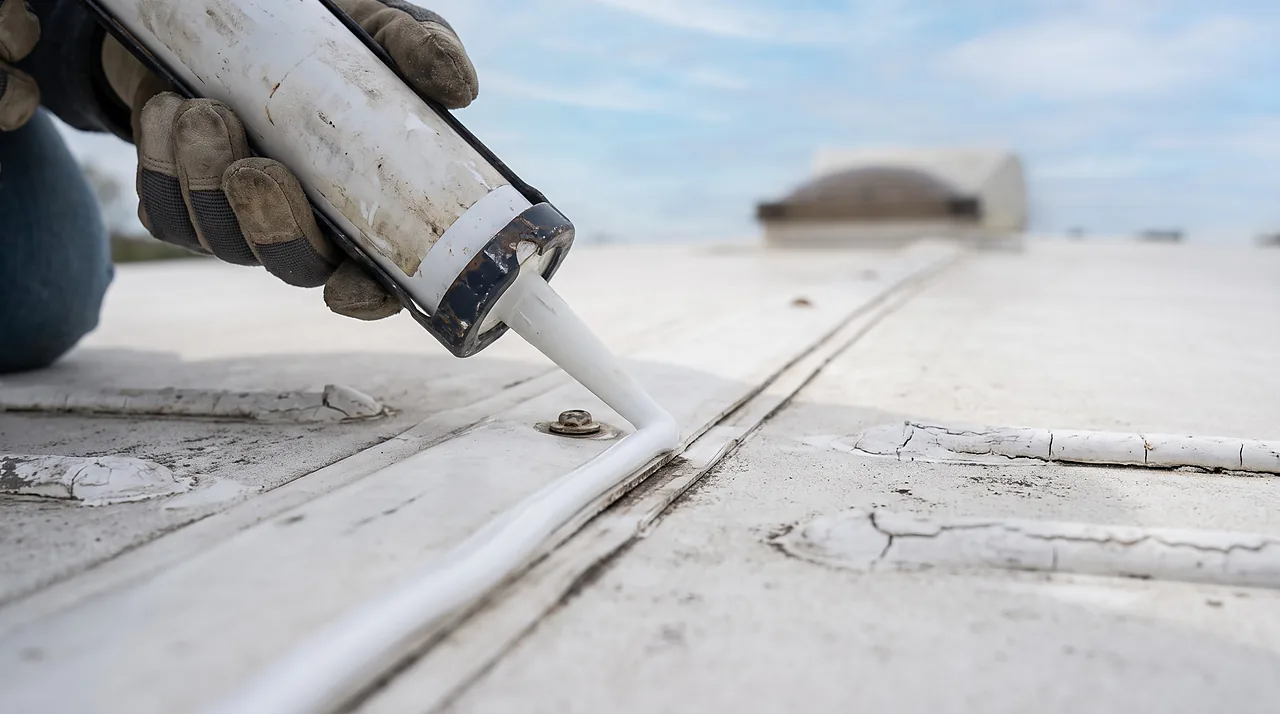
Stand on a stepladder with a bead of cracked lap sealant crumbling under your thumbnail, and the question isn't whether to reseal. It's which tube to grab. Pick wrong and you can pull a strip of EPDM loose during your next resealing job, or lay down a bead that never bonds to a TPO membrane at all. The roof membrane decides the chemistry. The surface orientation, horizontal deck or vertical trim, decides whether you want a self-leveling or a non-sag formula. Get both right and the sealant does its job for years. Get either wrong and you're back up on the roof sooner than you'd like, with a bigger repair on your hands.
This piece stops at the choice: matching product to membrane and to surface. Actually laying the bead, tooling it, and cure-time windows before it rains belong in the roof maintenance routine. If the membrane itself is torn, punctured, or delaminating, that's a membrane repair job, covered separately in the guide on rubber roof repair.
Lap sealant, sealant tape, or a roll-on coating?
Lap sealant seals seams, edges, vents and screw heads and is what this page is about. Sealant tape bridges a seam or a small tear in one pass and is covered in the sealant tape guide. A roll-on coating goes over the whole roof when the membrane itself is chalking or worn and is a different job, covered in recoating an RV roof. None of them substitutes for the others, so the question "what is the best thing to seal a camper roof" starts with which of these jobs you are doing.
Why the membrane matters more than the brand on the shelf
Three roof membranes dominate the RV market: EPDM (a synthetic rubber), TPO (a thermoplastic polyolefin), and fiberglass (a rigid, gel-coated laminate over the roof deck). They aren't chemically related, and a sealant that bonds beautifully to one can sit on top of another without ever really adhering.

Dicor's 501 and 551 lap sealant lines are formulated to bridge that gap: the company states plainly that its 501 and 551 sealants are compatible with EPDM, TPO, and PVC membranes. That's a real advantage for a shop or an owner who doesn't want three different tubes for three different roofs. But "compatible with all three" is a statement about that specific Dicor product line; it doesn't automatically extend to every other sealant on a shelf. A generic hardware-store silicone caulk was never engineered against any of the three, and once it cures, other lap sealants and seam tapes generally will not bond over it. Mixing sealant families under an RV roof causes more repeat failures than picking the wrong brand of a properly matched product. Other RV self-leveling lap sealants, Sika's included, follow the same rules: read the membrane list on the tube, then match it to the surface.
EPDM rubber roofs
EPDM is a synthetic rubber membrane, usually black or white, glued down over roof insulation. It's flexible, it moves with temperature swings, and it's the surface most lap sealants on the market were originally built for. A rubber-roof-specific lap sealant, or a multi-membrane product like Dicor's 501/551 line, is the safe default here. Avoid petroleum-based or solvent-heavy sealants and cleaners on EPDM; they can attack the rubber itself over time, well beyond the seam they were meant to fill.
TPO roofs
TPO looks similar to EPDM at a glance, usually white, but its underlying chemistry is a plastic. That changes how sealant grips it. TPO formulations also vary more between roof manufacturers than owners tend to assume; the material under one brand's roof and the material under another's aren't guaranteed to be the same recipe. The practical takeaway: confirm your specific roof manufacturer's sealant recommendation before assuming any TPO-labeled tube is a universal fit. A label that simply says "TPO" is a starting point for that conversation, and the roof manufacturer's own guidance should be the final word.
Fiberglass roofs
Fiberglass is the odd one out. It's a rigid, gel-coated laminate, and it's usually treated less as a sealant surface and more as a coated surface. Dicor's own fiberglass roof system illustrates the sequence: fasteners and roof protrusions get resealed with 501 lap sealant before the whole roof gets a dedicated acrylic coating, and the fiberglass gets cleaned first with a dedicated fiberglass prep product instead of plain soap and water. If you own a fiberglass-roofed rig, don't just walk out with rubber-roof lap sealant; check whether your roof calls for a fiberglass-rated sealant and a compatible coating system, because the two products are meant to work together.
Self-leveling versus non-sag: matching the product to the surface
This is the second decision, and it trips up almost as many owners as the membrane question. Lap sealant comes in two mechanical forms, and using the wrong one in the wrong orientation causes drips, sags, and thin spots that fail early.

| Sealant type | Where it goes | Why | Typical use case |
|---|---|---|---|
| Self-leveling | Horizontal surfaces only | Flows out flat under gravity to fill a level seam evenly; on a slope or a vertical face it just runs off before it sets | Roof deck seams, screw heads on the flat roof, flat lap seals around vents |
| Non-sag (non-leveling) | Vertical or angled surfaces | Thicker, stays where you put it instead of flowing, so it holds its bead shape on an upright face | Termination rails, corner moldings, vertical trim, the front cap-to-roof transition |
Dicor's own literature backs this split directly: the self-leveling formula is listed as being "for horizontal surfaces," and like most lap sealants it needs real time to move from freshly applied to fully cured; the specific timing windows for that process are covered in the roof maintenance routine. The non-sag line is built for vertical work and for termination rails, where a runnier sealant would simply slide down the wall before it ever sets.
A quick field test if you're not sure which tube you're holding: dab a small amount on a scrap piece of cardboard held at a steep angle. Self-leveling sealant will slump and spread toward flat. Non-sag sealant holds its shape where you placed it. If you can't test it, read the tube; reputable RV-specific sealants label this clearly, and if a product doesn't say one way or the other, that's a reason to put it back on the shelf.
A simple decision method: three questions before you buy
Skip the guesswork with three questions, in order.

- What's the membrane? EPDM, TPO, or fiberglass. If you genuinely don't know, look at your owner's manual or the roof manufacturer's plate, often near a roof vent; white EPDM and white TPO can look nearly identical, so color alone is an unreliable identifier.
- Is the target surface horizontal or vertical? A flat roof deck and a screw head call for self-leveling. A termination rail, a front cap seam, or any upright trim calls for non-sag.
- Does the product's own label state compatibility with your membrane? Don't assume; check the tube or the manufacturer's spec sheet. A sealant compatible with EPDM and TPO is not automatically rated for fiberglass, and a fiberglass coating system is not a substitute for lap sealant around fasteners.
Run those three in order and you'll land on the right tube close to every time, because the two variables (membrane chemistry and surface orientation) are independent of each other. A roof can be EPDM-and-horizontal, EPDM-and-vertical, TPO-and-horizontal, and so on. Treating them as one combined choice is exactly where owners go wrong: they remember "EPDM needs Dicor" and forget that the same roof still has a vertical termination rail that calls for the non-sag version of that same line.
Signs you grabbed the wrong sealant last time
- Sealant on a vertical rail that has slumped, thinned, or dripped down the siding: a self-leveling product was used somewhere it shouldn't have been.
- A bead on the flat roof deck that stayed thick and never flowed into the seam, leaving pinholes underneath: non-sag material applied where self-leveling was needed.
- Sealant that never fully bonded and can be peeled off in a sheet weeks later: often a membrane mismatch, or an older layer of silicone caulk underneath that nothing else will stick to.
- Chalky, cracked sealant well before the typical multi-year life of the product: sometimes ordinary UV aging, sometimes a cleaner containing petroleum distillates that attacked the sealant over time.
How often to check, and what it costs
Walk the roof and inspect every seam, vent and corner bead about every 6 months, and after any hail or tree strike. A tube of lap sealant typically runs about $10-20 (prices change, check current), which is small next to the cost of water damage in the ceiling. If a membrane type is unknown, identifying the roof membrane comes first; if a stain already shows on the ceiling, start with finding and fixing a roof leak.
Frequently asked questions
How long before a fresh sealant bead is safe from rain?
Self-leveling lap sealant skins over and turns water-resistant within hours in mild weather but takes much longer to fully cure; the exact window is printed on the tube and changes with temperature, so check it and the forecast before starting. The full staged cure timeline, and how to plan an application day around it, is covered in the roof maintenance routine.
If my fiberglass roof already has some cracking, do I need a full recoat or just fresh sealant?
Cracking limited to fastener heads or a single protrusion can often be handled with fresh 501 lap sealant on its own. Cracking or chalking spread across the broad coated surface usually means the roof is due for the acrylic recoat. Spot sealant applied to that kind of widespread surface damage will not hold up on its own, so a short inspection before you buy anything saves a wasted tube.
How do I tell EPDM from TPO if I don't know my roof's history?
Both are commonly white or gray membranes and can look alike from the ground. Check your owner's manual, the roof manufacturer's data plate near a vent, or ask an RV dealer to identify the membrane before buying sealant, especially if the roof has ever been replaced.
How do I strip old silicone caulk before applying new lap sealant?
Scrape it away mechanically with a plastic putty knife; a metal blade can gouge the membrane underneath. Once the bulk of the old bead is off, wipe the area with isopropyl alcohol or a manufacturer-approved cleaner to lift the remaining residue before laying the new bead. Ordinary citrus or soap-based cleaners will not dissolve cured silicone on their own, so budget time for that physical scraping step before you reach for any cleaner.
Read next
Keep going on this system
Sources
What this guide is based on
- Dicor Products, "Self-Leveling Lap Sealants"
- Dicor Products, "Non-Leveling Lap Sealants"
- Dicor Products FAQ
- Dicor Products, "Fiberglass RV Roof Coating"
Built from manufacturer manuals and published specifications. If something here does not match your appliance label or manual, the label and manual win.