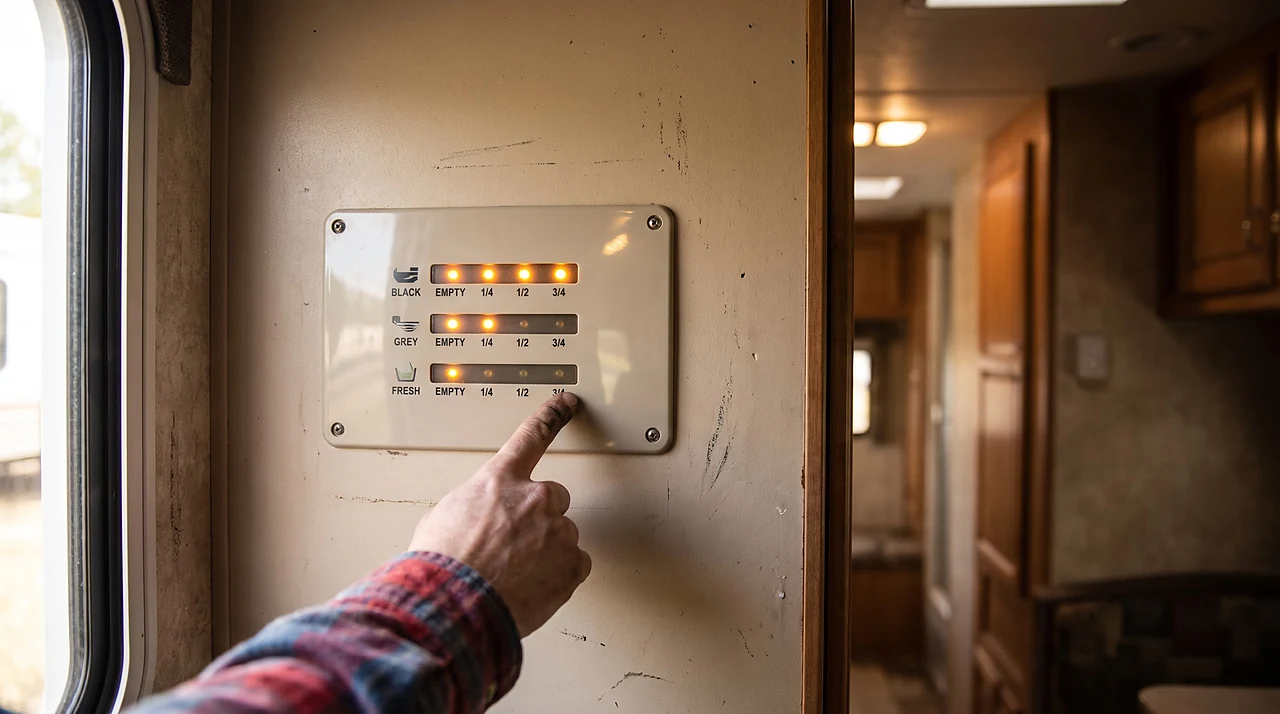
You just pulled the black tank valve, watched it run clear, closed it back up, and walked inside to check the monitor panel. All three lights are still on. Full. It has been full for two weeks straight, through three dumps, and you are starting to wonder if the tank itself is broken. The tank is very likely fine. A thin film sitting on the metal probes that stick into the tank is what is broken, and that film is lying to the panel long after the waste it came from is gone.
This is one of the most common holding tank complaints, and the root cause is a coating problem on the probes themselves. The fix has three real stages, and most owners skip straight to the third one (rewiring or replacing sensors) when the answer is sitting a few inches inside the tank wall.
Why the panel lies right after a dump
Factory tank monitors on most travel trailers, fifth wheels, and motorhomes use a row of metal probes bolted through the tank wall. On most factory panels they sit at about one-third, two-thirds and full. Each probe works like a simple switch: when waste touches it, electricity flows across the gap and the light turns on. When the tank is dumped, the liquid drains away. But a layer of toilet paper sludge, grease, and mineral scale often stays stuck to the probe itself, and that residue still conducts electricity almost as well as the waste did. Thetford, which makes a dedicated probe cleaner for exactly this problem, describes it as toilet paper sludge and soap scum buildup interfering with sensor operation. The tank can be bone dry and the panel will still read full, because the sensor is not measuring the tank at all. It is measuring whatever is stuck to it.

Black tanks earn this reputation more than grey tanks because solids and paper have somewhere to cling low in the tank, right where the lower probes sit. Grey tanks build a different kind of film, mostly soap and grease, which is why a kitchen sink full of dish suds does the grey tank sensor almost as much damage as toilet paper does the black one.
Rating the folk fixes
Every owner with a stuck sensor eventually finds the same forum thread full of home remedies. Some of them do something. Most of them never reach the real problem: the film bonded to the probe itself.
Ice cubes down the toilet, then driving around
What it really does: Ice melts within minutes in a tank that still holds several gallons of warm residual liquid, long before the RV covers enough rough road to scour anything. Any scouring that does happen only reaches loose debris on the tank floor; the bonded film coating a probe is a different problem entirely.
Verdict: Unproven for sensors. No tank monitor or treatment manufacturer recommends this method.
A squirt of dish soap in the black tank
What it really does: Cuts grease temporarily but foams, and the leftover foam and residue can itself coat probes further. Using it occasionally in small amounts does not cause the tank damage some owners fear, though it never actually cleans the probes.
Verdict: Doesn't fix the probes. May add to the film over repeated use.
Baking soda and vinegar
What it really does: The fizzing reaction is satisfying but weak against dense organic sludge, and there is no manufacturer guidance treating it as a probe cleaner.
Verdict: Doesn't reach the residue on the probes.
A tank rinse wand or built-in flush system run for several minutes
What it really does: Genuinely useful for knocking loose debris off the tank walls and clearing solids that never broke down. Worth doing before anything else, and part of routine maintenance either way.
Verdict: Helps, but usually not enough alone once a film has bonded to the probe.
An enzyme-based probe cleaner made for holding-tank sensors
What it really does: Formulated specifically to break down the toilet paper sludge and soap scum that sit on the probes, with a soak period long enough to actually dissolve the film into a rinseable residue.
Verdict: Works. This is the manufacturer-recommended fix, and it is the next stop before touching any wiring.
Non-contact sensor replacement (sleeved probes or exterior strip senders)
What it really does: Changes the sensing method itself so residue has nothing conductive to bond to, or moves the sensor outside the tank entirely.
Verdict: Works, and it is permanent. This is the rewire-last option, reserved for probes that clean up and re-foul within weeks.
The remedies that get repeated most often, ice, soap, baking soda, all target loose debris. The real culprit is a bonded film they never touch. The step that works is a genuine soak with a product built to dissolve that film, followed by enough rinse time to carry it out of the tank.
The cleaning method that clears the probes
Following the manufacturer protocol matters more than the brand of cleaner you grab. Thetford's instructions for a 40-gallon black tank: pour half a bottle of Thetford's probe cleaner through the toilet, fill the tank partway with water, then drive or otherwise agitate the RV so the solution reaches every probe rather than pooling under one. The company specifies doing this on a warm day above 75F, since the cleaner works better in warm weather, then letting it sit a full 24 hours before driving again to loosen what it softened, and finally dumping and rinsing. Grey tank probes get the same half-bottle treatment poured down a sink or shower drain. Other enzyme-based probe cleaners follow a similar pattern: half the bottle into an otherwise empty tank, filled with water, left to work for about 24 hours, then dumped whenever convenient.

Two details matter more than owners expect. First, the tank needs to be empty (or close to it) before you add the cleaner, so the enzymes and solvents can work directly on the probes and walls, with no half-full tank to dilute them. Second, skip the temptation to add a treatment on top of the cleaner during that 24-hour soak. Regular holding tank treatments and probe cleaners are built for different jobs; running the wrong one, or mixing bleach or Pine-Sol into either, risks the seals and gaskets in the dump valve for no gain on the probes themselves.
What "full" is actually supposed to mean
Part of the frustration comes from a mismatch in expectations as much as from dirty probes. A standard three-light monitor is not a fuel gauge. Each light is a simple on-off switch tied to one probe height, so the panel can only ever report three discrete states: past one-third, past two-thirds, full. It cannot show 62% or 34%; it jumps from one light to the next the moment liquid (or residue) touches the next probe up. That is normal behavior for a probe-based system even when it is working perfectly, and it is worth recalibrating around: a panel reading two-thirds is only a rough signal to plan a dump soon.
The exception is exterior strip sender systems. These mount on the outside of the tank wall, outside the waste stream itself, and display level in small steps across the whole range. Makers of these systems describe the senders as external strips taped to the tank exterior that read through the wall, which is also why they sidestep the residue problem: nothing conductive ever touches the waste itself.
A separate habit prevents a lot of this from starting. Dumping the black tank only once it is reasonably full keeps solids from drying against the tank floor and probes in the first place; leaving the valve cracked open while camping is the habit that causes this problem, and the full explanation lives in the black tank fundamentals. Adding 2 to 3 inches of fresh water back into the tank after every dump does double duty. It gives the next batch of waste somewhere to break down, and it keeps a thin layer of liquid moving across the lower probes, keeping them wetted and less likely to collect a dry coating.
When cleaning genuinely does not fix it
A probe cleaner soak resolves most false-full complaints, but not all of them. Before assuming the probes need replacing, rule out the boring failure first: a loose or corroded wire at the sensor board behind the monitor panel produces the exact same symptom as a fouled probe, and it is a five-minute check with a multimeter set to continuity, comparing each probe wire against ground with the tank empty and dry. Corrosion at that connector, common in trailers that see a lot of moisture near the underbelly, reads as a permanently full circuit no amount of tank cleaning will ever fix. A panel that reads nothing on every tank points to its fuse at the 12V fuse panel or power feed rather than the probes.

If the wiring checks out and a proper cleaning soak (done correctly, with enough soak time and agitation) still leaves the same probe reading full within a week or two of a clean dump, that probe has likely pitted or corroded enough to hold residue no matter how often it is cleaned. That is the point where swapping to a non-contact sensor solves the problem for good. Teflon-sleeved probes and exterior capacitive strips both remove the conductive path residue needs to fool the circuit. Once one of those replaces a bare metal probe, the false reading does not come back, and the sensor stops being a task that has to be repeated every few months.
Questions
What owners ask next
Why does only my black tank read full while the grey tank works fine?
It usually comes down to what runs through each tank rather than the tanks being built differently. Every flush sends paper past the black tank probes, so a film forms there on a fairly predictable schedule no matter how the RV is used. A grey tank only fouls quickly if it sees a lot of grease or heavy dishwashing; a rig used mostly for showers and light rinsing can go a long stretch without a stuck grey sensor. Heavy grey tank use (a full-time cook, a lot of pots and pans) closes that gap fast and puts both tanks on the same cleaning schedule.
Will adding more water to the tank clear a stuck sensor?
Not by itself. Extra water dilutes waste and helps prevent new buildup, but it does not dissolve a film that has already bonded to a probe. You need an actual soak with an enzyme-based probe cleaner, followed by agitation and a full rinse, to remove existing residue.
How often should I run a probe cleaner instead of a regular tank treatment?
Regular deodorizing treatment goes in every time you use the tank. A dedicated probe cleaner soak is a maintenance task, worth running every few months or as soon as a sensor starts reading wrong after a fresh dump, whichever comes first.
Is it safe to use bleach to clean stubborn sensor residue?
No. The damage does not show up right away; it shows up months later as a dump valve that no longer seats fully, weeping a thin trickle of odor or liquid even when closed, because the rubber seal has gone stiff and cracked from repeated chlorine exposure. An enzyme-based probe cleaner or a citrus-based holding tank treatment gets the same residue-cutting result without touching the seals, and either can be left to soak as long as needed without that risk.
Read next
Keep going on this system
Sources
What this guide is based on
- Thetford, Level Gauge Cleaner product page
- Valterra, Horst Miracle Probes product page
- Garnet Instruments, SeeLeveL FAQ
- Garnet Instruments, SeeLeveL II 3-Tank Series product page
Built from manufacturer manuals and published specifications. If something here does not match your appliance label or manual, the label and manual win.