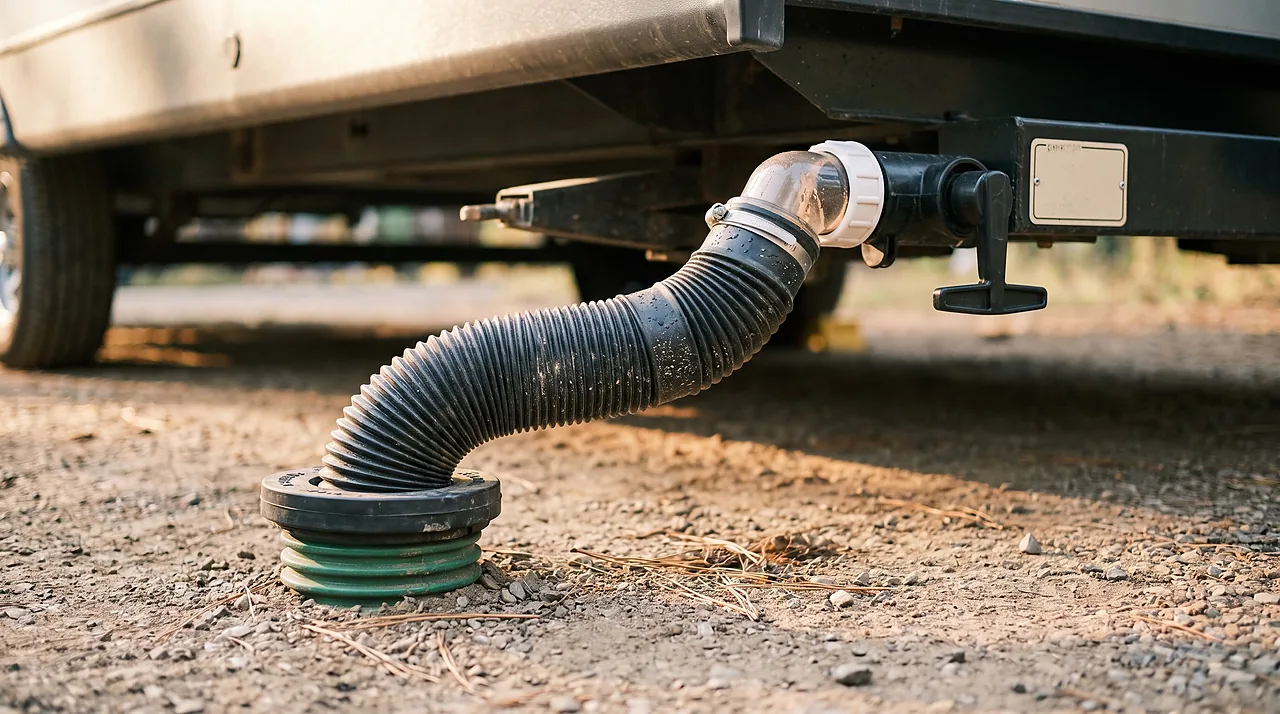
A camper at a full-hookup site with a sewer connection right at the pad often assumes the smart move is to leave the black tank valve open the whole stay. The idea is that nothing ever backs up. It is the opposite of smart. Thetford, one of the major RV toilet makers, is direct about it: never leave that valve open during use, sewer hookup or not. Leave it open and the liquid drains away fast. The solids stay put, stacking up directly under the toilet into a mound sometimes called the poop pyramid. Once that mound hardens, it can jam the toilet ball valve and clog the tank itself. No amount of tank treatment fixes a stack of solid waste sitting above the drain line.
The fix is a simple routine. Keep the black tank valve closed while camping. Let it fill to roughly two-thirds capacity, then dump, rinse, and add a few inches of water back before you close it up again. That is the whole system. Everything below explains why each step matters and where new owners go wrong.
Why the valve stays closed between dumps
A black tank only works if there is enough standing liquid to carry solids to the drain when you open the valve. With the valve closed, waste, toilet paper, and flush water collect together. The liquid volume does the job of keeping solids suspended and moving. Open the valve early, or leave it open, and gravity does something else entirely. The thin liquid runs straight down the 3-inch drain line. Anything solid or fibrous stays behind. It settles and compacts against the tank floor, right below the toilet inlet.
Thetford's own guidance draws a clear line between the two tanks in your rig. The grey tank only carries sink and shower water, so it can be left open at a full hookup because there is little solid material to strand. Grease and soap film are the main long-term buildup risk there, and even that eventually needs a flush with a tank cleaner. That same film is what makes a grey tank smell, so a grey tank that stinks usually needs a cleaner flush and a full dump rather than more deodorizer (see grey tank care). The black tank does not get that pass. It needs the closed-valve cycle every time.
The two-thirds rule and how to judge it
Dumping on a fixed calendar, say every three days, ignores how differently tanks fill. A family of five running two showers a day and a solo weekend traveler are not on the same schedule. The better trigger is the tank level itself. Once the monitor panel shows the black tank at roughly two-thirds full, it is time to dump, whether that happens on day two or day six. Waiting past that point risks a tank that reads full before you can get to a station. Dumping much earlier wastes the standing liquid that helps solids move.

That said, a monitor panel is only as accurate as its sensors. Black tank sensors are notorious for reading wrong long before the tank is actually full or empty. If yours has been stuck on two-thirds or full for days despite dumping, treat that as a sensor problem to investigate, not a reason to abandon the routine (see why tank sensors misread level and how to fix them).
Dumping and rinsing without a mess
A clean dump follows a simple order:

- Connect the sewer hose securely to both the tank outlet and the dump inlet before touching any valve.
- Open the black tank valve first and let it drain fully. The heavier, dirtier water clears the hose so the grey water that follows helps rinse it.
- Close the black valve, then open the grey tank valve to flush the hose with cleaner water.
- Close the grey valve, disconnect, and rinse the hose and connections with a dedicated non-potable water hose, never the drinking-water hose.
If your rig has a black tank flush port, run it for a full cycle or two after the initial drain. Let the tank fill partway and drain again before adding fresh water back. A rinse that only rinses the hose and skips the tank itself leaves solids stuck to the tank walls and sensor probes. That is exactly what causes the false readings covered above. And if the gravity dump itself is awkward where you park, because the sewer inlet sits uphill or too far from the outlet, a macerator pump setup grinds the waste and pushes it out through a narrow hose instead. Rinse the tank at every dump using built-in flush ports and tank wands after setting up the sewer hose, and plan a deeper clean when sensors start misreading after a rinse or before the rig goes into storage.
Adding water back in
Once the tank is empty and rinsed, add a few inches of water back through the toilet before you start moving again, along with a dose of enzyme-based or chemical tank treatment. An empty, bone-dry black tank has nothing to buffer odor and nothing to keep the next round of solids from drying onto the tank floor the moment they land; a few inches of water sitting in the bottom solves both problems at once. Skipping this step is one of the most common reasons a freshly dumped tank starts smelling within a day (walk through the full cause list in what actually causes RV toilet and tank odor).

Tank treatments matter here too, and not all of them do the same job. Enzyme and bacteria-based products break down waste and paper over time; chemical deodorizers mostly mask odor without breaking anything down. Picking the wrong one for your situation, or skipping it altogether, is a common way owners end up back at square one within a week (see the breakdown in how RV tank treatments actually work and which type to use).
Quick decision rules for the routine
Once the closed-valve habit is set, the day-to-day choices come down to matching your situation to the right valve position and action:
- Camping at full hookups, tank under two-thirds full: valve stays closed. Let the standing liquid and tank treatment keep working.
- Tank reads roughly two-thirds full: valve stays closed until you reach the dump station. Then dump, rinse, and refill with 2 to 3 inches of water.
- Monitor panel stuck on the same reading for several days: valve stays closed. Suspect a sensor fault before assuming the tank is truly full.
- Grey tank at a sewer hookup: the valve can stay open, but close it a day before you dump the black tank so there is grey water to rinse the hose. Give it a periodic flush with a tank cleaner to clear grease buildup.
- Long-term storage with the tank empty: valve stays closed. Leave a small amount of water and treatment sitting in the tank, unless the rig will sit through freezing weather; then follow the winterizing steps instead.
Deep cleaning when the routine rinse is not enough
After the normal dump, close the valve, fill the tank partway with clean water, and dump again, repeating once or twice until the clear elbow runs clean. A tank wand fed down through the toilet reaches the walls and sensor area a flush port misses. Filling the tank partway with water and an enzyme treatment before a drive lets the motion work the sides. If hardened waste or stuck sensors survive all of that, a professional tank cleaning service is the next step rather than harsher chemicals.
What causes real clogs
A poop pyramid that has been building for weeks is a different repair than a one-time slow drain. Overloading the tank with too much toilet paper, using paper that does not break down in water, or running the tank dry for long stretches all compound the same underlying problem: not enough liquid moving solids toward the outlet. If dumping on schedule with the valve closed has not solved a slow or blocked tank, the issue is likely already-hardened waste. At that point, the fix is mechanical or chemical breakup treatment for the hardened material, not another routine dump cycle. Start with the truth about which toilet paper is actually safe for RV tanks, then move to clearing a clogged black tank if the problem persists.
The toilet itself is worth ruling out too. A valve or seal can leak even slightly at the base. That small drip can add enough water into the tank between flushes to throw off both the odor picture and the sensor readings. It ends up mimicking a tank problem that is really a toilet problem (compare styles and common failure points in how the common RV toilet types differ, and troubleshoot a specific fault in diagnosing and repairing a leaking or sticking RV toilet).
When to stop and dig deeper
Two situations mean the basic routine is not enough on its own. The first: tank sensors keep misreading after a proper rinse and probe cleaning. That points to a fault in the sensor hardware or wiring, and it needs its own diagnosis. The second: odor persists even with a closed valve, correct dump timing, and fresh treatment in the tank. That usually means something else is venting sewer gas back into the cabin. A dry trap, a failed seal, or a blocked tank vent are the common culprits, and each needs its own fix.
Questions
What owners ask next
How do I manage the black tank when boondocking with no sewer hookup?
The same closed-valve, two-thirds-full trigger applies, but you are watching the monitor more closely because there is no drain right outside the door. Plan trips to a dump station around your expected fill rate rather than waiting for the tank to force the issue, and pack a portable waste tote as backup if you are camping somewhere remote for several days. Running the tank fuller than usual for a night or two is fine as long as you still dump before it reaches capacity.
Does dumping change in freezing weather?
Yes. Cold temperatures thicken the contents and can freeze a hose, a valve, or the water left in the tank if you wait too long between dumps. Dump more often in freezing conditions, use a heated or insulated hose if you have one, and avoid letting rinse water sit in an exposed hose after you disconnect. Skip the post-dump water top-up if hard freezes are expected overnight, since standing water in an unheated tank or line is what actually splits pipes and valves.
How long can I safely leave a full black tank before it becomes a problem?
A few extra days at capacity will not damage anything on its own, but the longer solids sit without fresh liquid moving through, the more they compact and the harder they get to clear on the next dump. Treat "full" as a deadline to get to a dump station within a day or two rather than a level you can sit at indefinitely.
How much tank treatment should I actually use?
Follow the dose printed on your specific product rather than guessing, since concentration varies a lot between enzyme, bacterial, and chemical formulas, and between tank sizes. Most are designed around one dose per dump cycle, added right after you refill with a few inches of water. Using less than the labeled dose is a common reason a treatment fails to control odor.
Can I use dish soap or other household products in the black tank?
Home mixes built on detergent are what owners call the Geo Method, and no manufacturer or lab has tested how well it works, so treat it as unproven rather than a fix. Plenty of water at each dump and the closed-valve routine above do more than any additive; tank treatments compared sets out what enzymes, bacteria, chemicals and the Geo Method each actually do.
Read next
Keep going on this system
Sources
What this guide is based on
- Thetford
- Camco
Built from manufacturer manuals and published specifications. If something here does not match your appliance label or manual, the label and manual win.