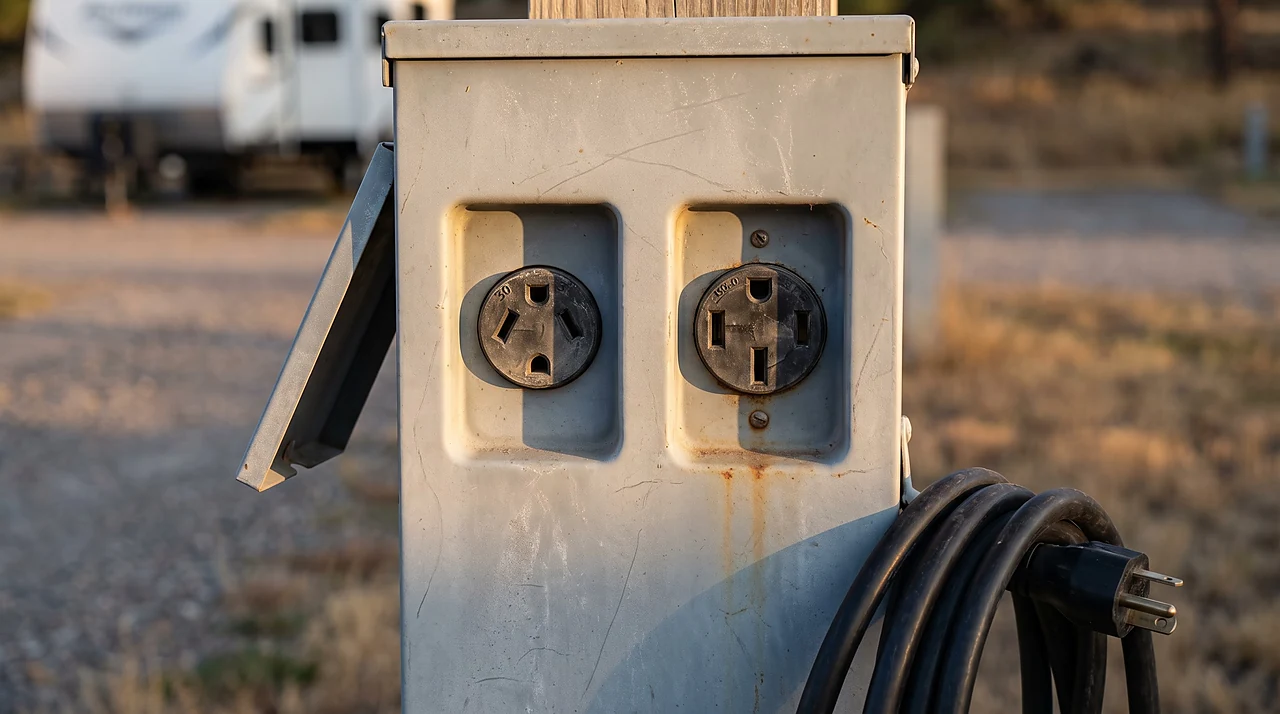
The air conditioner cycles on, the microwave door beeps, and the pedestal breaker snaps off before the popcorn finishes. That trip is not a bad breaker or a haunted campground. It is arithmetic. A 30-amp shore power connection has a hard ceiling of 3,600 watts, and once the running loads in the rig cross that line, something has to give. A 50-amp connection is a different animal entirely, with a ceiling more than three times higher, and the two services are not interchangeable no matter what adapter is in the bag.
Here is the number that ends the guessing: 30-amp service is 120 volts times 30 amps, which is 3,600 watts. 50-amp service runs two separate 120-volt legs at 50 amps each, for 12,000 watts combined. Surge protectors and EMS units are built to exactly those two ratings, 3,600 watts and 12,000 watts, because that is what each plug type can actually deliver. Once you know your rig's ceiling, counting appliances turns from a mystery into a checklist.
What each amp rating actually gives you
A 30-amp RV pulls from a single 120-volt circuit through a three-prong TT-30 plug. Every appliance in the rig, from the air conditioner to the converter that charges the house batteries, draws from that one 3,600-watt pool; see how the converter and inverter fit in. There is no second circuit to borrow from when the pool runs dry; the breaker at the pedestal or in the rig's own panel simply opens.
A 50-amp RV connects through a four-prong 14-50 plug carrying two hot legs, a neutral, and a ground. Each leg supplies up to 50 amps at 120 volts on its own, and the two legs together read 240 volts across them, but nearly everything inside the rig still runs on 120 volts pulled from one leg or the other. The RV's breaker panel splits circuits across both legs, air conditioner on one, water heater and outlets on the other, roughly balancing the load. Total available power is 12,000 watts, a little over three times what 30-amp service gives.
| Service | Plug | Voltage | Amps | Total watts | Typical rig |
|---|---|---|---|---|---|
| 30 amp | TT-30 (3-prong) | 120V, one leg | 30A | 3,600W | Small to mid travel trailers, one AC unit |
| 50 amp | 14-50 (4-prong) | 120/240V, two legs | 50A per leg | 12,000W | Fifth wheels, larger motorhomes, two AC units |
Why the breaker actually trips
Big loads are the whole story. A rooftop air conditioner typically runs somewhere around 1,500 to 1,800 watts once it settles in, but it can spike toward 2,500 to 3,500 watts for a second or two on startup, before the compressor gets moving. A microwave draws roughly 900 to 1,500 watts. An electric water heater element runs about 1,400 watts. A hair dryer or electric skillet can pull another 1,200 to 1,500 watts. None of those numbers alone looks dangerous. Stack three of them at once on 30-amp service and the math turns ugly fast.

Run the numbers for a common combination: an air conditioner holding steady at 1,600 watts, a microwave at 1,200 watts, and a residential-style fridge cycling its compressor at 700 watts. That is 3,500 watts already, before anyone turns on a coffee maker or the water heater kicks in on its own thermostat. Add the water heater's 1,400-watt element and the total jumps to 4,900 watts, well past the 3,600-watt ceiling, and the breaker does exactly what it is built to do.
The same combination on 50-amp service barely registers, because the AC and the water heater usually sit on different legs, each with its own 6,000-watt headroom (50 amps times 120 volts, per leg). That is the real difference between the two services: the pool of available watts is simply bigger and split two ways, giving the same appliances far more headroom to share.
Count your own load before you flip anything on
This is the part a breaker chart cannot do for you, because every rig's combination of appliances is different. Four steps get you a real number instead of a guess.
- Find the running-watt rating on each appliance's nameplate or in its manual. That steady running-watt figure is what matters for a load that will stay on for more than a few seconds; the momentary startup surge is a separate, brief spike that does not apply here.
- List every appliance you would realistically run at the same time: air conditioner, microwave, water heater, coffee maker, hair dryer, whatever is actually plugged in on a normal morning.
- Add the running watts together.
- Compare the total to your ceiling. On 30-amp service, stay under roughly 2,880 watts (about 80 percent of 3,600) as a working margin, since a breaker rated for continuous duty is generally sized with headroom rather than run flat at its limit. On 50-amp service, split the same math across each leg your panel assigns the loads to, aiming for roughly 4,800 watts per leg rather than the full 6,000.
| Appliance | Typical running watts | Typical startup spike |
|---|---|---|
| Rooftop air conditioner (13,500 BTU) | 1,500-1,800W | 2,500-3,500W |
| Microwave oven | 900-1,500W | - |
| Electric water heater element | 1,400W | - |
| Residential-style fridge (inverter models) | 150-700W | 700-1,200W |
| Hair dryer or electric skillet | 1,200-1,500W | - |
| Space heater | 1,200-1,500W | - |
These are typical published ranges that vary by model, so check the nameplate on your own unit before treating any figure here as exact. That single habit, checking the actual rating instead of assuming, is what turns a repeat breaker trip into a solved problem.
What an adapter can and can't change
A common misread is assuming a 50-amp rig plugged into a 30-amp pedestal through a dogbone adapter still gets something close to 50-amp power, because the cord came off a 50-amp coach. That assumption is wrong: the adapter is the limiting part of the connection, not a pass-through for a 50-amp rig's native capacity. The part for this pairing is a 50-amp female to 30-amp male dogbone adapter: its 30-amp male end plugs into the 30-amp pedestal receptacle, and its 50-amp female end accepts the rig's native 50-amp cord. Like other dogbone adapters built around a 30-amp leg, its wiring is rated 125 volts and 3,750 watts, essentially the same ceiling as native 30-amp service, well under the 12,000 watts a true 50-amp hookup provides. Plug a 50-amp rig into a 30-amp site through this adapter and every appliance in the rig is now sharing that smaller pool, whether the cord and plug came off a 50-amp coach or not.

The same logic runs in reverse, through a different part. A 30-amp rig plugged into a 50-amp pedestal uses a 50-amp male to 30-amp female dogbone adapter: its 50-amp male end plugs into the pedestal receptacle, and its 30-amp female end receives the rig's own cord. Even with the bigger pedestal behind it, the rig still only draws 30 amps total, because the rig's own internal wiring and main breaker were built for that ceiling. The pedestal having more available power does not push more into a rig that cannot accept it. For the full rundown on which adapter goes with which pedestal, and where a dogbone adapter is the right call versus the wrong one, that is a separate decision worth getting right before you buy one.
Let the calculator add it up
Adding up nameplate numbers by hand works, but it gets tedious fast once you are trying to plan a whole weekend's appliance schedule around one 30-amp site. The load calculator on this page does the same four-step math above automatically: enter your service type, add each appliance's running watts, and it totals the load against your real ceiling, 3,600 watts or a per-leg 6,000, and flags anything that pushes past the safe working margin before you ever hear a breaker snap.
What the watt math does not cover: pedestal protection
Getting the watt math right stops nuisance trips from overloading, but it does not protect the rig from a miswired pedestal, a surge, or low voltage, all of which are separate failure modes that show up at campgrounds more often than most owners expect. A surge protector or electrical management system rated for the correct amp service, 30-amp or 50-amp, checks the pedestal before power ever reaches the rig's own panel. Sizing and choosing one is covered in full in our surge protector guide, and it is worth reading before the watt math above ever gets tested at a real site. The broader picture of how the whole 12-volt and 120-volt system fits together, converter, battery bank, breaker panel, and shore connection, lives in our electrical basics rundown.

Practical steps to stop the trips
- Stagger big loads instead of running them together: let the water heater finish recovering before starting the microwave, or run the air conditioner and the hair dryer at different times.
- On 50-amp rigs, check which appliances share a leg in the breaker panel. Two heavy loads wired to the same leg behave like a 30-amp overload even though the rig has 50-amp service overall.
- Switch to an inverter microwave or a lower-wattage electric heater if 30-amp overloads happen often. Lower running watts means more headroom for everything else.
- Never assume a pedestal's posted amperage matches what it actually delivers. Test it before committing the whole rig to it.
Questions
What owners ask next
Should I ever stack two dogbone adapters together to reach an outlet?
No. Chaining a 50-amp-to-30-amp adapter into a second adapter to reach something like a 15-amp household outlet doubles up connections that were never designed to carry that load twice, and stresses prongs and contacts at each joint. Use a single adapter matched directly to the pedestal you are actually plugged into, not a chain of them.
Can I run two air conditioners on 30-amp service?
Generally not both at once. Two rooftop units typically draw 3,000 to 3,600 watts combined just running steady, which already sits at or past the 3,600-watt limit before anything else in the rig is on.
Why does my 50-amp rig still trip a breaker sometimes?
Usually because too many large loads landed on the same leg of the panel. Each leg has its own 6,000-watt ceiling, and the rig's total 12,000 watts only helps if the load is actually spread across both legs. A portable electrical management system that displays per-leg amperage is the easiest way to confirm which appliances share a leg without opening the panel and tracing wires yourself.
Is 50-amp service 240 volts throughout the rig?
No. The two 120-volt legs measure 240 volts across each other, but nearly every appliance and outlet inside the rig runs on 120 volts pulled from one leg or the other. A dedicated 240-volt circuit, uncommon but occasionally wired in for a residential-style washer/dryer combo in larger fifth wheels, would be the exception; check your rig's own wiring diagram if you are unsure whether it has one.
What is the difference between running watts and startup watts?
Running watts is what an appliance draws once it is operating steadily. Startup watts, sometimes called surge or LRA (locked rotor amps) on compressor-driven appliances, is a brief higher draw at the moment it switches on, usually lasting a second or two.
Is a 30-amp RV 120 or 240 volts, and can I plug it into a 30-amp outlet at home?
A 30-amp RV runs on 120 volts through a TT-30 receptacle. A household 30-amp dryer outlet is 240 volts and has a different shape, and forcing an RV onto it with an adapter can send 240 volts into 120-volt appliances and damage them. At home, use an RV-rated TT-30 receptacle installed by an electrician or a properly wired 50-amp 14-50 outlet with the right adapter.
Can I convert a 30-amp RV to 50-amp?
It is possible, but it means a new shore cord and inlet, a new main panel with two legs, and rewiring, which is electrician work. Most owners use the right adapter and manage loads instead.
Read next
Keep going on this system
Sources
What this guide is based on
- Progressive Industries
- Camco
Built from manufacturer manuals and published specifications. If something here does not match your appliance label or manual, the label and manual win.