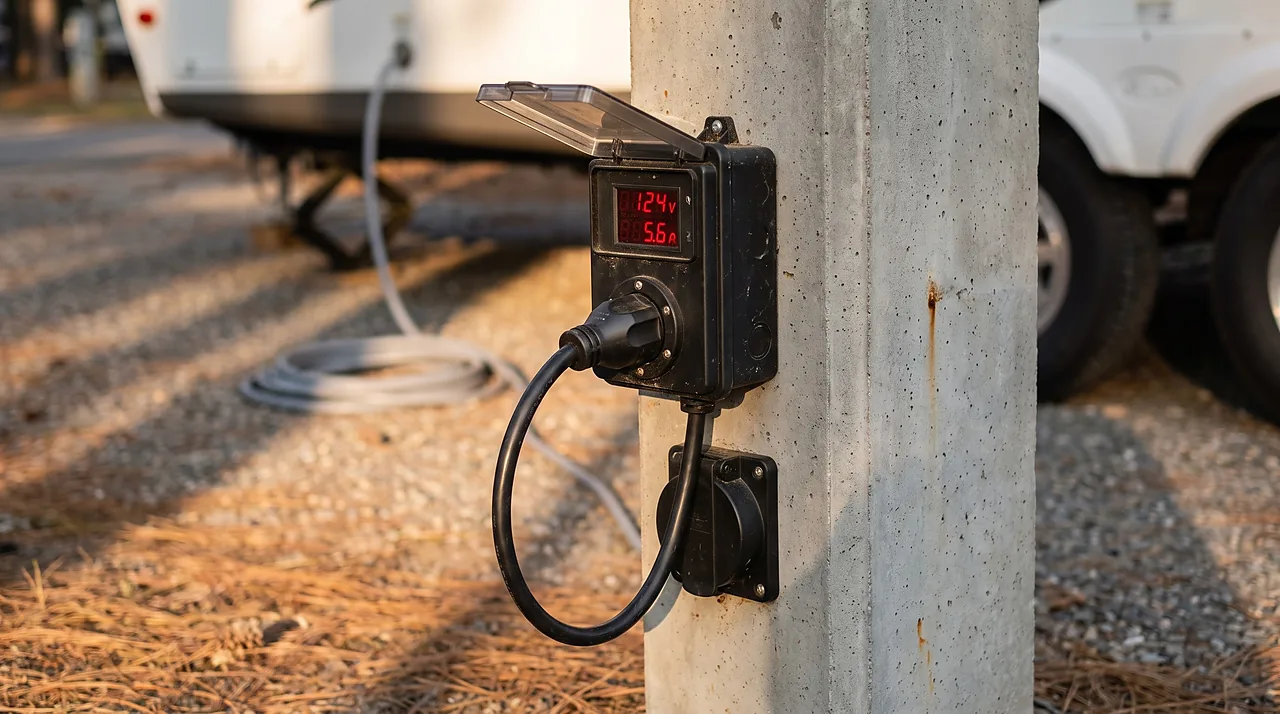
Somebody at the last campground told you their converter died, or their air conditioner quit mid-July, and it started with a pedestal that "just felt off." Now you're standing in an aisle looking at a box near the bottom of the roughly $100-350 range (prices change, check current) and one near the top that both say "surge protector" on the label, and the box copy all sounds the same. It isn't the same. The cheaper box stops spikes. The pricier box stops spikes and also watches the steady voltage coming out of that pedestal, second by second, and cuts your rig off before a slow brownout finishes what a lightning strike would have done in an instant.
That difference has a name. The cheaper box is a surge protector. The pricier box is an Electrical Management System, usually shortened to EMS. Both use the same joule-rated components to absorb a spike. Only the EMS also measures line voltage, frequency, and wiring condition continuously and disconnects your RV when any of those drift outside a safe window. The spike is the dramatic failure. The brownout is the common one, and it's the one that gets missed.
What a basic surge protector actually does
A surge-only unit is, at its core, a set of metal-oxide varistors wired between hot, neutral, and ground. When voltage spikes hard and fast (a lightning strike nearby, a utility switching event, a large motor cycling on a shared transformer), those components clamp the spike and shunt the extra energy to ground before it reaches your converter, appliances, or electronics. One 30A surge-only unit from a well-known manufacturer, checked directly against its own instruction manual, carries an 825-joule rating, a 22,500-amp surge-current rating, and a response time under one nanosecond. It also has LED indicators that light up for reverse polarity, open neutral, and open ground, so you know the pedestal is wired wrong before you plug in further.

What that same manual does not describe anywhere is an automatic shutdown for sustained low or high voltage. The LEDs tell you something is wrong. They do not disconnect your RV and hold it off until the pedestal stabilizes. That's the whole gap in one sentence, and it's worth sitting with, because most of what actually damages RV electrical systems over a season isn't a spike at all.
What only an EMS adds: continuous voltage and frequency monitoring
An EMS runs the same surge-clamping hardware, then wraps a monitoring circuit around it that never stops watching three things: voltage, frequency, and wiring integrity. On a widely used 30A/50A EMS pairing, the low-voltage cutoff trips whenever line voltage drops below 104V for more than 6 seconds, and the unit won't reconnect until voltage climbs back above 104V and then holds through a 136-second delay. The high-voltage side is tiered rather than a single trip point: above 132V but under 140V for more than 3 seconds, above 140V but under 156V within 1 second, and above 156V within 60 milliseconds. That tiering matters. A brief flicker to 135V while the AC cycles on isn't treated the same as a genuine 160V fault, and the unit doesn't sit there hunting for a false trip.

The same 136-second delay shows up again for a specific reason stated plainly in the manufacturer's own manual: it exists to protect the air conditioner compressor, which is the single most voltage-sensitive appliance most RVs carry. Reconnecting power to a compressor that just lost power and is still pressure-equalizing is a fast way to trip its internal overload or shorten its life, so the EMS forces a cooldown window before power returns, on every single fault, not just voltage faults.
Beyond voltage, the same unit refuses power outright for reverse polarity, open neutral, open ground, and AC frequency outside 51 to 69 Hz, each flagged with its own error code rather than a generic warning light. A surge-only unit with fault LEDs will show you a reverse-polarity indicator. An EMS goes a step further and won't energize your coach at all until that condition clears.
Why the brownout is the more common threat, not the more dramatic one
Lightning-driven spikes make for a good campfire story. Brownouts are quieter and far more frequent, because they come from ordinary, boring causes: an overloaded park transformer on a 100-degree afternoon when forty rigs are running air conditioning at once, undersized or aging feeder wire at an older park, or simply being at the far end of a long run of pedestals. None of those need a storm. They just need a hot Saturday.

The mechanism that does the damage is basic motor electricity, not anything exotic. An air conditioner compressor motor is built to run at a design voltage. When the supply sags, the motor still tries to produce the same torque, so it draws more current to make up the difference, and that extra current becomes heat inside the windings. A single afternoon of that rarely kills anything. A summer of repeated sags, especially ones that go unnoticed because nothing trips and nothing beeps, is what shows up later as a compressor that hums and won't start (see an AC that is not cooling), or a weak AC capacitor worn down from riding the ragged edge. A basic surge-only protector, sitting right there on the pedestal the whole time, does nothing about any of it, because sagging voltage isn't a surge. There's no spike to clamp.
This is also where the industry itself has been catching up, more slowly than first announced. The 2023 National Electrical Code dropped the older reverse-polarity-device requirement for RV park pedestals and replaced it with a requirement for a ground-monitor interrupter (GMI), because a reverse-polarity check alone never caught a "hot skin" fault where the RV's metal frame becomes energized from a lost ground. RVIA originally targeted 2026 for adoption, but its Board has since delayed the enforcement date because no listed GMI devices actually exist yet for RV use; the current target is around June 1, 2027, timed to coincide with model year 2028. Until parks are required to run GMI-equipped pedestals, and for a good while after that date arrives, an onboard EMS that checks ground continuity every time you plug in is still doing a job the pedestal itself isn't yet required to do.
Where the extra money actually goes
None of this means the joule rating stops mattering. It's just not where the two categories separate. Compare the two devices from the same manufacturer directly: the 30A EMS carries a higher joule rating (1,790 J) than the 30A surge-only unit (825 J) from the same lineup, so in this case the EMS isn't even giving up surge capacity to add voltage monitoring. That won't hold true across every brand and every model pair, so check the actual joule number on the unit you're looking at rather than assuming EMS automatically means "more joules." The added price is buying the monitoring circuit, the voltage and frequency thresholds, the wiring-fault lockout, and the display that tells you what the pedestal is actually doing in real numbers, not just a pass/fail light.
If your rig has no air conditioner, runs mostly on a 30A cord at parks you already trust, and you're budget-constrained, a surge-only unit with fault-indicator LEDs still beats plugging straight into the pedestal with nothing at all. If you run an air conditioner regularly, tow into unfamiliar parks, or you've already had one bad pedestal experience, the monitoring is the part of the protection you're actually missing.
Spec criteria to check before you buy either one
Skip the star ratings and check the actual document. Every legitimate unit publishes these numbers; if a listing doesn't, that's itself a signal to keep looking.
| Spec to check | What it tells you | What to look for |
|---|---|---|
| Category | Surge-only vs. EMS | Does the manual describe an automatic low/high voltage shutdown, or only surge clamping plus indicator lights? |
| Joule rating | How much surge energy it can absorb before the protection module is spent | A stated number in the 800 to 3,600 J range depending on amperage class; avoid listings with no joule figure at all |
| Low-voltage cutoff | Whether it catches brownouts at all | A stated trip voltage and a time delay before it trips (a delay avoids false trips from brief dips) |
| High-voltage cutoff | Whether it catches overvoltage from a miswired pedestal or a bad transformer tap | A stated trip voltage, ideally tiered so a fast, severe overvoltage trips faster than a marginal one |
| Reconnect delay | Whether it protects your air conditioner compressor on every reconnect, not just after a voltage fault | A stated delay (roughly two minutes is typical) before power returns after any fault clears |
| Wiring-fault detection | Whether it catches a miswired pedestal before you ever draw power | Explicit coverage of reverse polarity, open neutral, and open ground, not just a generic "fault" light |
| Amperage class and form | Whether it matches your cord and your 30A or 50A shore power service | Portable (plugs into the pedestal, you carry it) vs. hardwired (installed inline in the coach, always protecting even if you forget to plug in the portable) |
That last row matters more than it looks. A portable unit only protects you the trips you remember to use it on. A hardwired unit, installed at the point where shore power enters the coach, protects every connection automatically, which is worth factoring into the price gap once you count the number of stops per season. Either way, the fundamentals of how the pedestal feeds your coach, the neutral-ground bond, the breaker sizing, are covered in more depth in our rundown of RV electrical basics, which is worth reading once before any of this hardware makes full sense.
Questions
What owners ask next
Does a surge protector or EMS protect against a direct lightning strike?
No unit sold for RV pedestal use is rated to survive a direct strike; both categories are built to clamp induced spikes and switching transients from the grid, not a direct hit. If lightning is close enough to be a real risk, disconnect and wait it out regardless of what's plugged in.
Can I use a 30A EMS on a 50A pedestal with an adapter?
Only through a proper dogbone adapter, and the EMS will still limit protection to its own 30A rating, not the pedestal's 50A capacity. Match the unit's amperage to your RV's actual shore cord, covered in our 30A vs 50A guide, not to whatever the campground happens to offer.
My EMS shows a brief low-voltage error when the air conditioner first kicks on. Is that a bad pedestal?
Not necessarily. A large motor starting draws a momentary inrush that can sag voltage for a second or two; that's why these units use a several-second delay before tripping. A fault that clears itself in a second or two, without the unit actually cutting power, is usually normal motor starting behavior, not pedestal damage.
Is a hardwired EMS worth it over a portable one?
A hardwired unit protects the coach on every connection without you remembering to set anything up outside, and it's harder to steal off the pedestal. A portable unit is cheaper up front and works across multiple RVs, but only if you actually use it every time.
Does the response time in nanoseconds actually matter?
It matters for the surge side, since a spike can reach damaging levels within microseconds and a slower clamp lets more energy through before it reacts. It has nothing to do with how fast the unit reacts to a brownout, which is measured in seconds, not nanoseconds, on purpose, so normal motor-starting dips don't trip it constantly.
How many joules does an RV surge protector need?
Joules measure how much spike energy the unit absorbs before its protection is spent; look for a stated rating, expect higher numbers on 50A units, and treat it as a tiebreaker, since whether the unit also cuts power on low and high voltage (EMS) matters more than a few hundred joules. A unit that has absorbed a big hit may need replacing; many have an indicator that says so.
How do I keep a surge protector from being stolen at the pedestal?
Many portable units have a hole or bracket for a padlock that closes through the pedestal door or the protector itself; a cable lock around the pedestal post also works; a hardwired unit sidesteps the problem because it lives inside the coach.
What should never be plugged into a surge protector?
The pedestal protector plugs straight into the pedestal with the shore cord into it, not after a chain of adapters or a household power strip; inside the rig, high-draw heaters and similar loads do not belong on household-style power strips.
Read next
Keep going on this system
Sources
What this guide is based on
- Progressive Industries EMS-PT30X & EMS-PT50X Instruction Manual
- Progressive Industries SSP-30XL Instruction Manual
- RV Industry Association (RVIA)
Built from manufacturer manuals and published specifications. If something here does not match your appliance label or manual, the label and manual win.