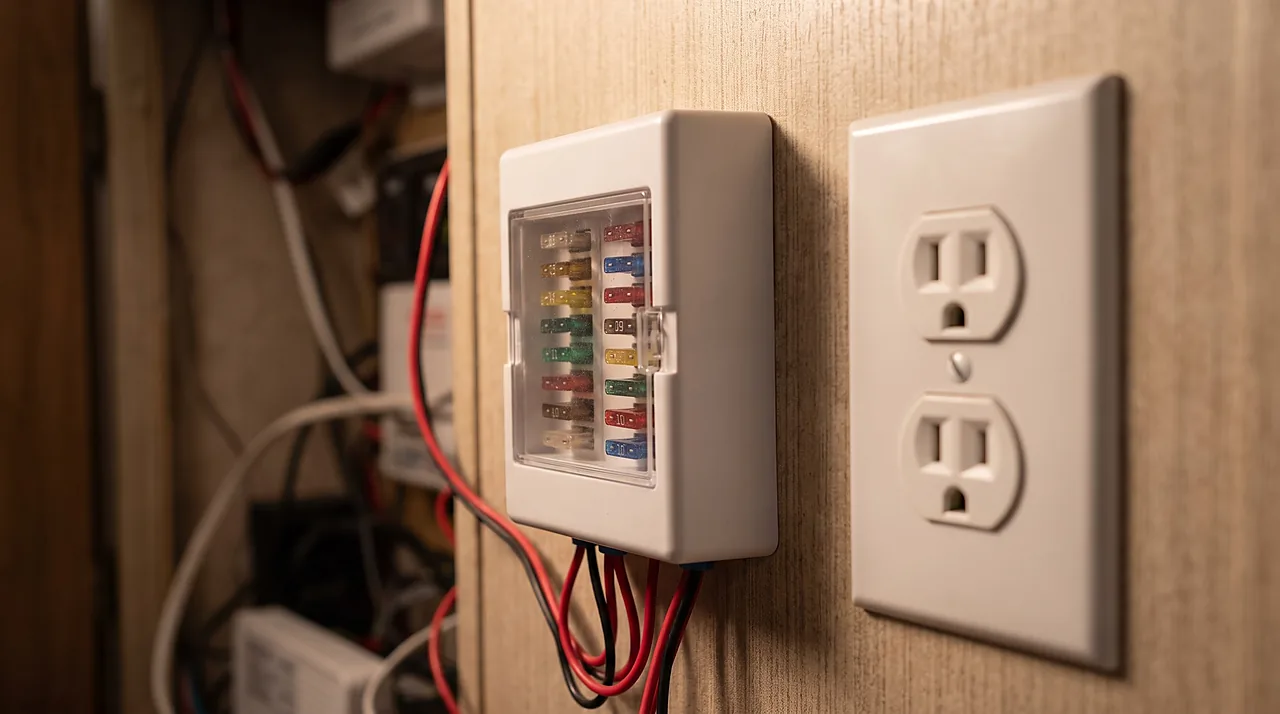
Your rig has two separate electrical systems running at once, and almost every "why did this die" moment traces back to not knowing which one you're standing in. Unplug from shore power and the ceiling lights, the water pump, and the furnace fan keep working fine. The microwave, the outlets by the counter, and the air conditioner go dark the second that cord comes out. Nothing is broken. Two different power systems share one rig, and once you can point to which system an appliance lives in, the "converter versus inverter" confusion mostly disappears.
The two systems: 12V DC and 120V AC
One system runs on 12-volt direct current (DC), stored in your house battery or batteries. It powers the ceiling lights, the water pump, the furnace's fan and control board, the refrigerator's control circuit, slide-out and awning motors, the roof vent fan, and the 12V outlets that charge phones through a cigarette-lighter-style plug. This system does not care whether you're plugged into shore power, running a generator, or sitting off-grid at a trailhead. As long as the battery holds a charge, it works.
The other system runs on 120-volt alternating current (AC), the same kind of power that comes out of a wall outlet at home. It runs the microwave, the residential-style outlets, the air conditioner, and usually the water heater's electric element and the fridge's AC heating element if it has one. This system needs either a shore power cord plugged into a pedestal, a generator running, or an inverter turning battery power into AC. Pull the plug with no generator and no inverter, and everything on this side goes quiet immediately.
Where the converter fits: charging the 12V side
A converter's whole job is to take the 120V AC coming in from shore power or a generator and step it down into 12V DC, which does two things at once: it runs your 12V appliances directly and it charges the house battery. Picture it as a one-way gate, AC in, DC out. Most converters push out somewhere in the 13.2 to 14.4 volt DC range while actively charging, tapering down once the battery is closer to full. If the converter fails or a fuse blows, the 12V lights and pump usually keep running for a while on stored battery power alone, then dim and fade as that charge drains with nothing replacing it. That slow fade, not a sudden blackout, is usually the first clue a converter has stopped doing its job.

Signs a converter is failing
- The house battery runs down even while the rig is plugged in.
- 12V lights dim or flicker on shore power when they should be steady.
- The battery voltage does not rise when you plug in, which a basic multimeter at the battery shows.
- The converter's cooling fan never runs or the unit is silent and cold under load.
For step-by-step troubleshooting when these signs appear, see the walkthrough on a converter that stops charging.
Where the inverter fits: making AC from the battery
An inverter runs the opposite direction. As Xantrex puts it, "an inverter converts DC power from your batteries into AC power for appliances." So instead of shore power feeding the battery, the battery feeds an appliance that expects a wall outlet. This is what lets some rigs run a microwave or charge a laptop through a residential outlet while boondocking with no cord plugged in anywhere. Not every rig has one factory-installed; plenty of older or entry-level trailers rely on shore power or a generator for every AC-side appliance and have no inverter at all. Some rigs combine both jobs into a single box, an inverter/charger, which switches direction automatically depending on whether shore power is present. Adding one to a rig that never had it, and sizing it to the loads you actually want to run, is its own project covered in the basics of sizing and installing an inverter.

| Question | Converter | Inverter |
|---|---|---|
| Direction of conversion | AC in, DC out | DC in, AC out |
| Power source | Shore power or generator | House battery |
| What it feeds | 12V lights, pump, furnace board, and charges the battery | Microwave, AC outlets, other 120V loads |
| Works with no shore power? | No output; battery just discharges | Yes, that's the whole point |
| Common failure sign | Battery slowly fades over hours instead of staying topped off | Outlets go dead even though 12V lights still work |
Which appliance lives on which side
This is the part worth keeping handy, because it turns "is this a 12V problem or a 120V problem" into a five-second check instead of a guessing game.
| Appliance or circuit | System | Runs without shore power/generator? |
|---|---|---|
| Ceiling and reading lights | 12V DC | Yes, off the house battery |
| Water pump | 12V DC | Yes |
| Furnace fan and control board | 12V DC | Yes (propane is the heat source, but the fan and igniter need 12V) |
| Refrigerator control circuit | 12V DC | Yes, cooling itself may run on propane or AC depending on mode |
| Slide-out and awning motors | 12V DC | Yes |
| 12V phone-charger-style outlets | 12V DC | Yes |
| Residential-style wall outlets | 120V AC | Only with shore power, generator, or an inverter |
| Microwave | 120V AC | Only with shore power, generator, or an inverter |
| Air conditioner | 120V AC | Only with shore power or a generator (inverters rarely handle AC start-up load) |
| Water heater electric element | 120V AC | Only with shore power or a generator |
A quick load check, short of a full load calculation
Say four people are parked for a long weekend, plugged into a 30-amp pedestal. They want to know if they can run the microwave, the coffee maker, a hair dryer, and the air conditioner without tripping the breaker. A 30-amp, 120-volt hookup tops out at 3,600 watts (30 amps multiplied by 120 volts). A microwave draws roughly 1,000 to 1,200 watts. A coffee maker draws around 900 to 1,200 watts. A hair dryer draws 1,200 to 1,800 watts. A single RV air conditioner draws about 1,500 watts running, with a brief spike higher at start-up. These are typical figures; the label on each appliance gives its real draw. Add the AC and the coffee maker alone and you're already past 2,700 watts before anyone touches the hair dryer or the microwave. Layer in one more appliance at the same moment and the breaker trips. The math simply doesn't fit in 3,600 watts.
A 50-amp service changes that math completely: two separate 120-volt legs add up to roughly 12,000 watts total, which is why larger rigs with two air conditioners and a full kitchen's worth of appliances are built around 50-amp service instead of 30-amp. This section is only the quick gut-check version; the full breakdown of amperage, plug shapes, and how to actually total up a rig's simultaneous draw lives in the separate piece comparing 30-amp and 50-amp service, and that's the better stop if the goal is planning exact loads rather than understanding why the pedestal breaker just tripped.
Why the battery itself matters to both systems
Because the 12V side runs everything from lights to the furnace's control board, a weak or deeply discharged house battery causes problems that look electrical but are really just battery health. Lead-acid batteries last longest when they aren't run all the way down. Trojan Battery, a deep-cycle battery manufacturer, generally recommends "a discharge of 20 to 50% of the batteries rated capacity even though the battery is capable of being cycled to 80%." In practice, treat roughly half of a lead-acid battery's rated capacity as the working buffer. Don't count on the full tank, especially heading into an overnight stretch without shore power. A battery run too low doesn't just dim the lights. Furnace igniters typically fail to light below about 10.5 volts, so a furnace that blows air but never lights is often a tired battery, not a bad furnace. When troubleshooting a furnace that won't ignite, ruling out a battery that won't hold a charge is the first step before replacing components. That's one more reason a tired battery deserves attention before it becomes a no-heat problem at 2 a.m.
When shore power looks fine but nothing on the AC side works
If the pedestal has power, the cord is seated, and the 12V lights are on, but the outlets and microwave are dead, the issue almost always sits between the pedestal and the panel rather than inside the appliances themselves. A miswired or underpowered pedestal, a tripped breaker at the box, or a transfer switch stuck between shore and generator mode are the usual suspects, and each one leaves a different, checkable clue rather than requiring a guess. Working through shore power connection problems covers that pedestal-to-panel gap in detail, and if the rig switches between shore power and a generator automatically, the guide to how a transfer switch works explains the specific failure mode where it gets stuck mid-switch and leaves the AC side dark on both sources.

Protecting the system you now understand
Once the two sides of the system are mapped out, the most common way owners lose an inverter, a converter, a microwave, or an entire panel is a bad pedestal at the campground. The rig itself is rarely the problem. Reversed polarity, an open ground, or a voltage surge at a campground box can hit before anyone notices anything's wrong, and it hits the 120V side hardest since that's what's plugged directly into the outside world. A dedicated surge protector rated for the service (30-amp or 50-amp, matching the cord) between the pedestal and the rig is the standard defense, and the rundown on choosing and using one covers what an $100 to $350 unit actually catches versus what a bare adapter does not.
Once you know which side of the panel an appliance lives on, most electrical surprises stop being surprises. A dark outlet, a fading light, or a tripped breaker each point to one system or the other before you ever open a panel cover, and the guides linked throughout this piece cover what to do once you've narrowed it down.
Questions
What owners ask next
My inverter trips or shuts off when I try to start the air conditioner. What does that mean?
It almost always means the inverter isn't sized for the AC's start-up surge. That's usually a sizing mismatch rather than a failing inverter. Air conditioner compressors draw several times their running wattage for a fraction of a second at start-up, and a stock or undersized inverter protects itself by tripping rather than letting that spike through. Running the AC on shore power or a generator instead, or upgrading to a purpose-built inverter system sized for that surge, are the usual fixes.
Does adding solar panels change any of this?
Solar only changes how the battery gets charged. It doesn't change which system runs which appliance. Panels feed a charge controller that tops off the same house battery a converter would, so the 12V side still runs off battery power and the 120V side still needs shore power, a generator, or an inverter. Solar mainly extends how long you can go without plugging in, especially paired with an inverter for AC-side loads.
If my house battery is bad, will my 12V appliances just run weaker, or stop working entirely?
It depends on the appliance. Lights typically dim and pumps run slower as voltage sags, giving some warning. Circuit boards, like the ones in a furnace or refrigerator, are less forgiving: many are built to cut out or refuse to start below a minimum voltage threshold rather than limping along, so a bad battery can take out board-controlled appliances abruptly while lights are still faintly glowing.
Do I need both a converter and an inverter?
Most rigs need a converter, since it's what charges the house battery and keeps the 12V system alive. An inverter is optional and only matters if you want AC-side appliances, like a microwave or wall outlets, to work while boondocking with no shore power or generator.
What size inverter does a typical rig need?
Size the inverter to the AC loads you actually want to run at the same time, and size the battery bank to how long you want to run them, since a large inverter drains a small battery bank fast; the walkthrough in the inverter install basics covers both.
Read next
Keep going on this system
Sources
What this guide is based on
- Go RVing (RV Industry Association)
- Xantrex
- Trojan Battery Company
Built from manufacturer manuals and published specifications. If something here does not match your appliance label or manual, the label and manual win.