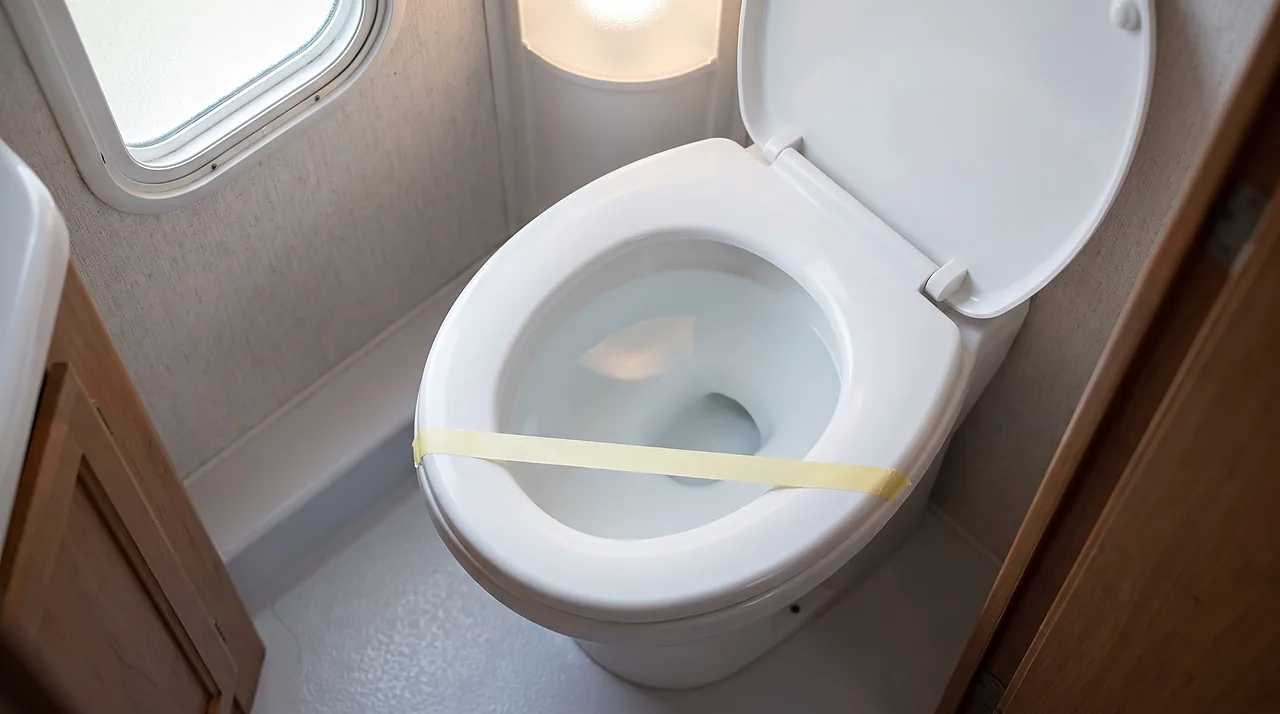
Windows down at 60 mph and the cabin still smells like the inside of a portable job-site toilet. That's a specific kind of miserable, and the instinct is always the same: blame the toilet. Sometimes that is exactly right. Often it is not. An RV has at least five separate places a sewer-gas smell can start, and the toilet bowl itself is only one of them. Chasing the wrong one wastes a weekend and a tube of sealant.
This article puts the five sources in the order worth checking, gives a real diagnostic order to work through them in one sitting, and stops right at the edge of the actual repair, which gets its own dedicated guide.
Why the nose lies about where the smell is coming from
Hydrogen sulfide, the compound behind that classic rotten-egg smell, is detectable by the human nose at extremely low concentrations, roughly 0.01 to 1.5 parts per million, according to OSHA's hazard data on the gas. That sensitivity is a curse here: a trace amount leaking from a vent on the roof can fill a 250-square-foot living space just as convincingly as a real problem at the toilet, and the smell alone tells you nothing about volume or location. Sound travels; sewer gas just accumulates wherever airflow is weakest, which in a moving rig is usually the bathroom and the area right behind the dinette.
One more reason not to trust your nose past a certain point: at higher concentrations the gas actually numbs your sense of smell rather than intensifying it, per the same OSHA data, which is a hazard in confined spaces but mostly irrelevant at RV-level concentrations. The practical takeaway for a rig is simpler: don't diagnose by sniffing around one fixture and stopping. Work the list in order.
The five real sources, in the order to check them
Every one of these has shown up as "the" cause on forums and in service bays. Here they are in the order worth checking, quickest and cheapest first, with the fastest field test for each, so you can start at the top and work down.
Rank 1: A dry P-trap under a sink, shower, or tub. Every drain that sits unused for a week or two loses its water seal to evaporation, opening a direct path to tank gas.
Sniff-test locator: run water in every drain for 20-30 seconds, then smell again after 10 minutes.
Rank 2: Worn or dry toilet blade/ball seal. The seal that closes between flushes hardens or wears a track, letting black tank air seep past the bowl.
Sniff-test locator: watch the water level in the bowl; if it drops over a day, air is moving the other way too.
Rank 3: Blocked, cracked, or missing roof vent cap. The vent pipe is supposed to carry tank gas up and away, and a cap knocked loose, cracked, or nested in by birds pushes it back down instead.
Sniff-test locator: look at the roof cap from the ground with binoculars, or check for a missing cap after a low branch strike.
Rank 4: Tank pressure changes while driving. Sloshing tanks push air out through any weak seal at speed, even ones that hold fine parked.
Sniff-test locator, driving-vs-parked fork: compare smell strength right after a drive against smell strength after the rig has sat still for an hour. Smell that's worse right after driving points at a seal under load somewhere in the tank system. Smell that stays about the same whether the rig just moved or has been parked all day points away from this source and back toward the trap, seal, or vent instead.
Rank 5: A biofilm layer built up inside the grey water tank. Soap scum, grease, and food residue coat the tank walls and slowly off-gas on their own, independent of any leak.
Sniff-test locator: smell right at an open grey tank drain valve versus inside the cabin; if it's only strong at the valve, this is it.
1. Dry P-traps: the first thing to rule out
This is the one people skip because it feels too simple. A P-trap holds a couple of inches of standing water specifically to block gas, and plumbing code treats that seal as something that has to be actively maintained: fixtures that don't run often enough are required to have a way to top the trap back up, according to the International Plumbing Code's general trap section. An RV amplifies the problem. A guest bathroom sink, a rarely used shower, even a washing machine drain if the rig has one, all sit idle between trips far more than a house fixture does, and two inches of water in a half-inch line evaporates fast in a hot cargo bay or a closed-up rig baking in a driveway.

The fix costs nothing and takes five minutes: run every drain in the rig, including ones you never use, for at least 20 to 30 seconds. Do it before every trip, not just when the smell shows up, because by the time you notice the odor the trap has usually been dry for days.
Many RV sinks vent through an air admittance valve under the sink instead of a pipe to the roof. The valve lets air in when water drains and should seal against sewer gas the rest of the time. A stuck or failed valve lets odor into the cabinet even with a full trap. Smell that is strongest inside a sink cabinet points there, and the valve unscrews for replacement.
2. The toilet's blade or ball seal
Most RV toilets use a rubber blade (or a ball, depending on the model) that closes against a seal between flushes. Grit from flushing, hard water minerals, and simple age wear a track into that rubber, and once the seal stops closing fully it does two things at once: it lets bowl water seep down slowly, and it lets tank air seep up. Manufacturers like Thetford sell a dedicated, non-petroleum seal lubricant specifically because petroleum-based grease breaks rubber down faster than it protects it, so reaching for whatever's in the toolbox can make this worse, not better.

You can confirm this one without opening anything: watch the water line in the bowl over 12 to 24 hours. A level that drops on its own, especially paired with a faint smell right at the base of the toilet, points here. Diagnosing it is as far as this guide goes; pulling the toilet, inspecting the seal track, and doing the actual seal swap is covered step by step in our toilet seal replacement walkthrough, since that job deserves its own attention rather than a rushed paragraph.
Smell that hits right when you flush
Opening the toilet valve opens the tank for a moment, and if the bathroom roof fan is running in exhaust mode, or a window on the other side is creating a draft, the cabin is pulling tank air up through the toilet. Turn the fan off or flip it to intake while flushing, keep water in the bowl, and the puff usually stops. If it does not, a blocked tank vent is the next suspect.
3. A damaged, blocked, or missing roof vent cap
Every RV tank system vents to the roof through a plastic stack, and that vent is what lets gas escape outside instead of building pressure and pushing back into the cabin through the path of least resistance. A cracked cap lets wind gust down the pipe instead of pulling air up and out. A cap that's gone entirely, usually from a tree branch on a tight campsite road, does the same thing more directly. Wasp nests and, in warmer climates, actual bird nests are a common blockage; a partially clogged vent doesn't stop the tank from venting, it just makes the airflow lazy and inconsistent, which shows up as an odor that comes and goes with the wind direction.
This one needs eyes on the roof, or at least binoculars from the ground if you're not comfortable climbing up. Look for a cap that's cracked, discolored and brittle, sitting crooked, or simply not there.
4. Tank pressure while the rig is moving
A tank that seals fine parked in the driveway can still leak air at highway speed. Liquid sloshing against the tank walls and against any gate valve seal briefly increases internal pressure, and a marginal seal, whether it's the valve gasket, a loose termination fitting, or a P-trap that was only barely holding, gets pushed past just enough to let odor through. This is why the smell often shows up specifically after a drive and fades once the rig sits still: highway vibration and sloshing push a seal that was already borderline past the point where it can hold quietly. If the smell tracks with driving more than with time-since-last-dump, look at valve seals and fitting connections before assuming the tank itself is at fault.
5. A film of buildup inside the grey water tank
Grease, soap residue, food particles, and hair don't always rinse straight through a grey tank; some of it sticks to the walls and settles into a coating that keeps producing odor on its own, with no leak involved anywhere. This is a slower, quieter source than the other four, building gradually over a season of dishwashing and showers, and it's the reason two identical rigs with identical plumbing can smell completely different by August. Routine additions of an enzyme or bacterial tank treatment help break that layer down before it accumulates, which our breakdown of what actually works in a tank treatment covers in more depth, including which ingredients are marketing and which do real digestion work. Frequent full-tank flushes and hot water dumps also help keep the coating from setting up in the first place.

A five-minute order to actually find yours
Don't fix all five at once and hope. Work through them in this order on one afternoon, and you'll usually land on the answer:
- Run every drain in the rig for 20-30 seconds, wait 10 minutes, and reassess. This rules out (or confirms) dry P-traps immediately, and it's free.
- Mark the toilet bowl water line and check it again the next morning. A drop points to the seal.
- Walk outside and eyeball the roof vent cap, or send someone up if you're parked level and it's safe to do so.
- Note whether the smell is worse right after driving or right after sitting. Driving-heavy smell points at valve or fitting seals under load.
- Open the grey tank valve outside (with the sewer hose connected and the black valve closed) and smell right at that connection versus back inside the cabin. If it's strongest at the valve and mild inside, buildup in the tank itself is your answer.
Most rigs turn out to have more than one of these going at once, especially a dry trap stacked on top of an aging seal, which is exactly why a single fix often only helps partway.
What this doesn't replace
If the diagnostic points at the seal, the actual teardown and replacement procedure lives in the dedicated seal replacement guide rather than here, since it involves specific bolt patterns and seal types that vary by toilet model. If everything above checks out clean and the smell is still there, the next step is usually tank-level: our full black tank care guide walks through fill levels, dump timing, and the sensor issues that get mistaken for odor problems.
Questions
What owners ask next
Is a sewage smell in my RV actually dangerous, or just unpleasant?
At the low concentrations typical of a leaking seal or dry trap, it's a maintenance issue. OSHA's hazard data on hydrogen sulfide shows real health effects starting at occupational-exposure concentrations far above what a home or RV interior reaches from a plumbing seal. Ventilate, find the source, and fix it. A strong, persistent smell, or headaches or nausea, means do that now rather than later, since at higher concentrations the gas dulls the sense of smell instead of getting stronger.
Why does the smell only show up after I've been driving?
It usually means the question isn't whether a seal leaks, but at what pressure it starts to. Rough, washboard gravel tends to expose a marginal seal faster than smooth highway miles do, since repeated jolts work a loose fitting harder than steady vibration does. If the smell shows up after a short bumpy campground road but not after a long steady highway stretch, suspect a loose termination fitting or valve gasket over the tank itself, and check those connections before assuming a P-trap dried out in a single day's drive.
I already ran the five-step check and two sources came back positive at once. What's next?
Fix the cheaper, faster one first and retest before touching the other. A dry trap and a worn toilet seal often show up together, and a trap that's been dry for days can make a fine seal look suspect just from the residual smell, so refill every trap, wait a full day, and recheck the bowl water line before ordering seal parts. If every one of the five sources has genuinely checked out clean and the smell persists, or the odor still tracks with wind direction even with an intact-looking vent cap, that's the point to call an RV tech for a smoke or pressure test on the vent stack rather than keep guessing at fixtures.
Can a tank treatment fix a smell caused by a seal or a vent?
No. Treatments address bacterial buildup and waste breakdown inside a tank; a dry trap, a worn seal, and a blocked vent are physical air paths that no additive can seal. Diagnose the source first so you're not buying a product to solve the wrong issue.
Why does my RV smell like rotten eggs?
That odor points to three different causes depending on where it appears. Propane has a rotten-egg odorant added for safety, so a strong smell near the stove, furnace, or fridge, or an alert from the propane detector, means shut the gas off at the tank, ventilate immediately, and do not use switches or flames. A smell that only comes from the hot water tap is usually the water heater, caused by bacteria reacting with the anode rod, which is fixed by sanitizing the water heater. A smell from drains or the toilet is sewer gas from the plumbing sources covered on this page.
Read next
Keep going on this system
Sources
What this guide is based on
- OSHA (Occupational Safety and Health Administration)
- International Plumbing Code (as compiled by UpCodes)
- Thetford
Built from manufacturer manuals and published specifications. If something here does not match your appliance label or manual, the label and manual win.