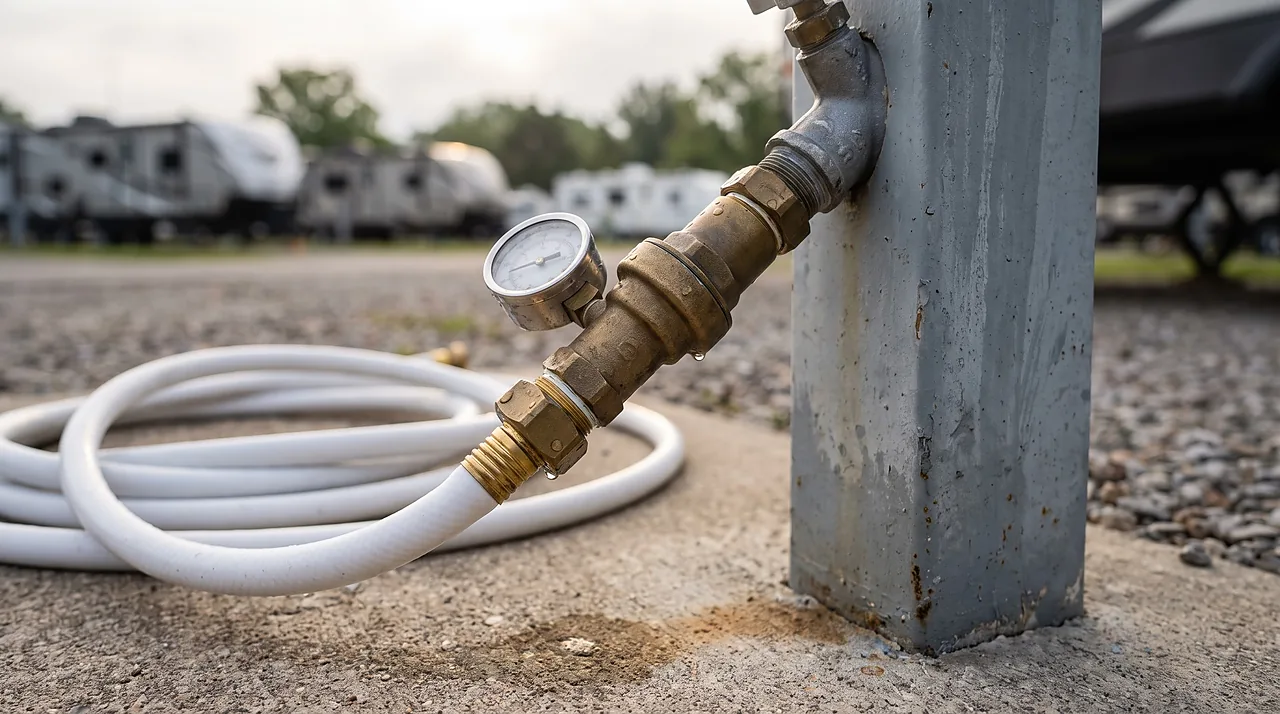
Screw a regulator onto the spigot before you connect city water, full stop. Every campground pedestal runs off municipal or well pressure sized for a house's plumbing, and that pressure can spike well above what a trailer's fittings are built for, with no warning anywhere on the hookup. RV plumbing, by contrast, is built to handle roughly 60 psi before fittings, the water pump's demand valve, and appliance connections start to fail. A regulator sits between the spigot and your fresh water hose and knocks that incoming pressure down to a working range the whole system can live with indefinitely.
The real decision isn't whether to regulate. It's which regulator: a small brass barrel that locks in one fixed range, or an adjustable model with a gauge that lets you dial the number in yourself. Both do the same core job. The difference is entirely about flow rate and control, not about whether one is "safer" than the other.
Why 60 psi is the number that matters
Municipal water systems are allowed to deliver quite a bit more pressure than an RV was ever designed around. A city main can run well above 60 psi at certain times of day, and a spike on top of that, common enough in RV parks that owners trade stories about it in every camping forum, can push a hose bib well past what your rig's plastic fittings, water heater tank, and pump check valves are rated to hold. Camco markets its RV regulators specifically to stop that kind of damage to plumbing, hoses, and appliance connections, and every model the company sells is built around keeping delivered pressure at or below 60 psi.

That 60 psi ceiling isn't a guess. Adjustable RV regulators typically ship preset in the middle of the 40-50 psi window, and their makers advise against dialing past 60 psi. The high inlet rating printed on a regulator describes what the regulator itself can survive from the spigot side; it says nothing about what your plumbing can take.
Connect straight to a spigot with no regulator, and you are betting that the campground's pressure never spikes above what your weakest fitting can take. Connect through a regulator set anywhere in the 40-50 psi window, and that bet is off the table.
What actually happens above 60 psi
Unregulated high pressure doesn't usually blow something up on day one. It works slowly. A slip joint under the kitchen sink weeps a little more each week. A water heater's relief valve starts dribbling (see a water heater relief valve that drips) because the tank sits at the edge of its rating even before the burner fires. A supply line fitting that was hand-tight from the factory finally lets go at 2 a.m. while you're asleep two feet away from it. None of that requires a dramatic pressure event, just steady operation above the range the plumbing was built for.

This is also why "the campground says their pressure is fine" isn't something to take at face value. Pressure at a shared pedestal varies through the day as neighboring sites turn faucets on and off, and a regulator is the only thing standing between whatever the main is doing at 6 a.m. and your galley faucet.
Fixed vs. adjustable: the real trade-off
Once you accept that anything in the 40-50 psi zone is the safe target, the choice between a basic fixed regulator and a pricier adjustable one stops being about protection and becomes a question of how much flow you're willing to trade for how much control.
Compare what each style actually delivers. A fixed inline regulator locks output at a preset in the safe range, with no gauge and nothing to adjust: you are trusting the factory spec every time you hook up. An adjustable regulator covers a wider adjustable band with a built-in gauge so you see the live number rather than assume it.
The price and upkeep split along the same line. A fixed unit costs a fraction of an adjustable one (check current prices) and asks almost nothing of you beyond cleaning the inlet screen occasionally. For an adjustable model, along with the same inlet-screen cleaning, it's worth re-checking the gauge each trip since the setting can drift or get bumped in transit.
Where each one earns its keep also differs. A fixed regulator suits owners who want to connect and forget it: it caps you at a safe number and that's the whole feature set. An adjustable regulator suits owners chasing better shower or faucet flow without exceeding 60 psi, or troubleshooting a weak-flow site, since it doubles as a diagnostic tool. A site with genuinely low incoming pressure (some older or rural parks run noticeably low) benefits from dialing closer to 50 psi for a decent shower, while a site running unusually high can be dialed down toward 40 psi for extra margin. If your shower suddenly turns weak, the regulator gauge tells you at a glance whether the problem is upstream (low incoming pressure) or downstream in your own plumbing.
Turning the pressure down (or up)
With a faucet running a little, turn the adjustment screw or knob slowly while watching the gauge, stop inside 40-50 psi, then close the faucet and confirm the reading holds; direction is marked on the cap or in the instructions. A fixed regulator cannot be adjusted; if it delivers the wrong pressure, replace it.
A quick way to decide which one fits your rig
Run through these four questions before you buy:
- Do you camp almost exclusively at full-hookup campgrounds and rarely think about water pressure day to day? A fixed 40-50 psi brass regulator covers you and you're done.
- Do you regularly hit older parks, boondocking-adjacent sites with community wells, or destinations known for weak pressure? An adjustable model with a gauge lets you claw back flow without guessing.
- Have you had a slow leak, a weeping fitting, or a relief valve that dribbles more than it should? That's often years of unregulated or over-regulated pressure catching up with the plumbing; an adjustable unit with a gauge helps you find and hold the right number going forward.
- Is this your first regulator ever? Start with a fixed one. You can always add a gauge model later once you have a feel for how much the pressure actually varies where you camp.
Either choice keeps you under the 60 psi ceiling that matters. Beyond that ceiling, the deciding factors are flow rate and everyday convenience, and how often you land on a weak-pressure site is what should tip you toward paying more for a gauge.
Hooking it up correctly
The regulator threads onto the spigot first, before your fresh water hose. Water flows through the regulator, then down the hose to your city water inlet. Installing it backwards, hose to spigot and regulator at your rig's inlet, still knocks the pressure down, but it leaves the entire length of hose between the spigot and the regulator exposed to full, unregulated pressure the whole time you're hooked up. Keep the regulator at the spigot end. If you also run an inline water filter, the usual order is spigot, regulator, filter, hose, so the filter housing also sits on the regulated side (see choosing an RV water filter setup).

Check the inlet screen every few trips. Debris from an old spigot or a shared hose bib collects there over time, and a clogged screen can choke flow even though the regulator itself is working fine. A quick rinse under the sink solves it.
A pressure regulator is one piece of a larger fresh water setup that also includes your pump, filter, and inlet fitting; if you're building or troubleshooting that whole chain, the fresh water system overview covers how the pieces connect end to end.
Questions
What owners ask next
Do I need a regulator if my RV has a built-in pressure-reducing valve?
Some newer rigs do have a factory regulator on the internal plumbing, but it's rarely documented well enough to trust blind. Run an external regulator anyway; it's cheap insurance and it protects the hose itself, which a factory internal valve does not.
Can I just watch my pump's pressure switch instead of using a regulator?
No. The pump's pressure switch controls what the pump itself produces from your fresh tank. It has no effect on incoming city water pressure at all, so it can't protect you from a high-pressure spigot.
My regulator gauge reads a normal 45-50 psi, but the shower is still weak. What's going on?
If the gauge already confirms a normal reading at the regulator, the regulator isn't the bottleneck. Work downstream from there: check for a partially closed valve, a kinked hose, a clogged inlet screen or in-line filter, or scale buildup inside the showerhead itself, since any of those can choke flow even when incoming pressure is exactly where it should be.
How do I know when a pressure regulator needs to be replaced?
A quality brass regulator holds up for many seasons if you rinse the inlet screen and don't leave it to freeze in storage. Treat it as due for replacement once it stops holding a steady reading, drifts noticeably from a known-good spigot's pressure, or won't dial back to its set point after adjustment, rather than continuing to troubleshoot the rest of the plumbing for a problem that's actually the regulator itself.
Read next
Keep going on this system
Sources
What this guide is based on
- Camco
- Camco
- Camco
- Valterra
Built from manufacturer manuals and published specifications. If something here does not match your appliance label or manual, the label and manual win.