Somebody in an RV forum once described flipping the water pump switch before bed, forgetting about it, and waking up to a hissing sound under the dinette seat where the fresh tank fill line sits. Nothing had broken yet. The fear in that post is common for new owners, though: is the pump supposed to run all night, and did leaving it on wreck something? The short version is that it probably did not hurt anything by itself, but it points at a bigger gap in understanding how the system is built to run.
A travel trailer, fifth wheel, or motorhome gets pressurized water two different ways, and only one of them should ever be active at a time. Mode one pulls stored water out of the fresh tank using a 12-volt demand pump. Mode two skips the tank and pump completely and pressurizes the plumbing straight from a campground spigot through a hose. Confusing the two, or running both switches on at once, is where new owners get into trouble.
The two supply modes, side by side
Every fixture in the rig, the kitchen faucet, the shower, the toilet valve, draws from one shared plumbing loop. What feeds that loop depends on which mode is active.
Mode 1: Pump mode (dry camping)
Fresh water tank → 12V demand pump → shared plumbing loop → faucet
Water source: the onboard fresh water tank.
What pressurizes it: a 12V demand pump, cycling on when a faucet opens and pressure drops.
Switch or connection: the 12V water pump switch, usually near the entry door or on a monitor panel.
Turn it on when: no hose is hooked up, or you want to conserve water off-grid.
Main risk if mismanaged: the pump runs dry and burns out if the tank empties with the switch left on.
Mode 2: City water mode
Campground or home spigot → hose → city water inlet → shared plumbing loop → faucet
Water source: the campground or home spigot, an unlimited supply.
What pressurizes it: municipal or well pressure, which can run well above what RV plumbing is built for.
Switch or connection: a hose threaded into the city water inlet on the trailer's exterior.
Turn it on when: you are parked with a hookup and want continuous flow without draining the tank.
Main risk if mismanaged: unregulated spigot pressure splitting a fitting or blowing a supply line.
Notice the pump switch and the city hose connection are not linked to each other electrically or mechanically in most rigs. Nothing stops you from leaving the pump switch on while also hooked to city water, and nothing stops you from hooking up a hose while the tank still has water in it. The system will not sort out the conflict for you. That part is on the owner.
How pump mode actually behaves
Flip the 12V switch and nothing happens right away, because these are demand pumps that sit idle until a pressure drop tells them to run. Open a faucet, pressure in the line drops, and an internal pressure switch senses that drop and kicks the motor on. Close the faucet and pressure climbs back up until the switch trips off again. That is the on-off chatter you hear through the wall when someone runs water with the pump switch flipped.

Leaving the switch on with no faucet open, the scenario from that Reddit post, is not dangerous by itself. If nothing is drawing water and the lines hold pressure, the pump simply sits idle and draws no meaningful current while it waits. The real risk shows up if a fitting is already loose, a fixture is left cracked open, or the tank runs dry with the switch still live. Running a demand pump with an empty tank can damage it, so keep an eye on the fresh tank gauge whenever the switch is on. If a pump seems to run constantly with every faucet closed, that usually points to a leak somewhere in the line instead of a broken switch, and it is worth working through the checks in a pump that will not build pressure or keeps running before assuming the worst. The pump is a 12-volt motor, so it runs from the house battery, and when the rig is plugged in the converter supplies that 12 volts.
How city water mode actually behaves
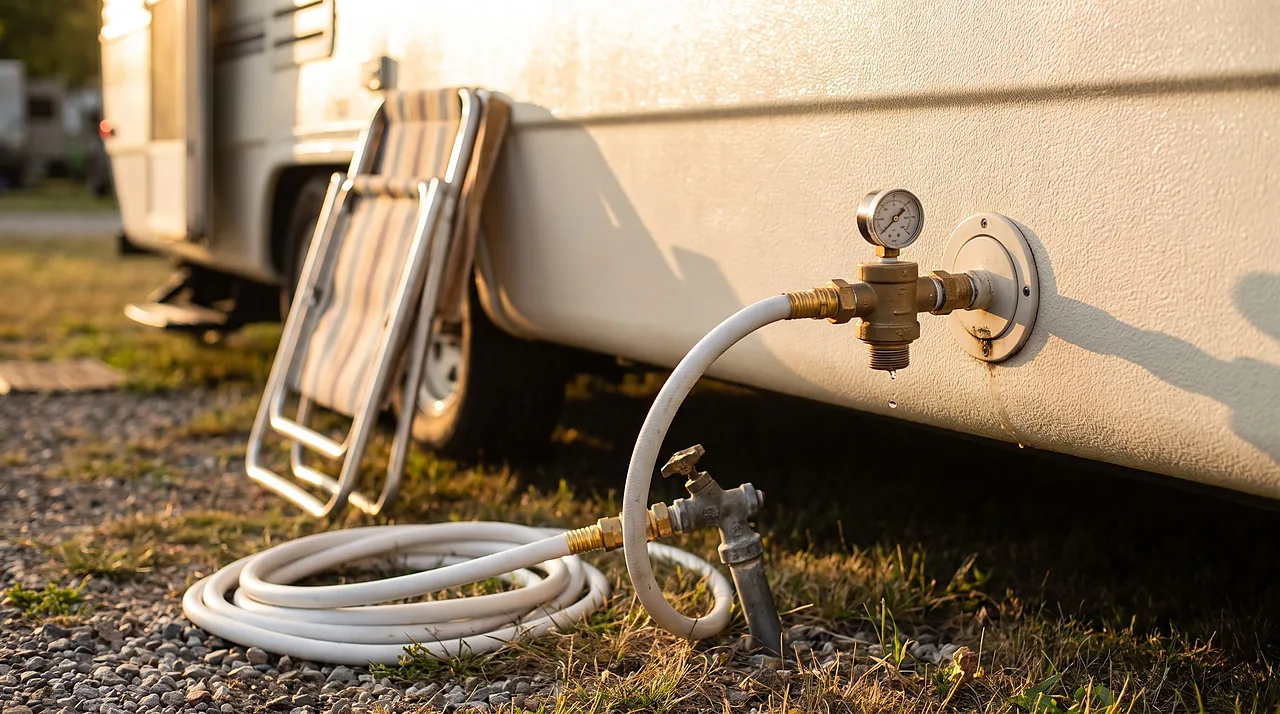
Thread a drinking-water-rated hose from the spigot into the trailer's city water inlet and the tank and pump are bypassed entirely. Pressure now comes from wherever that water originated, and that is the part new owners underestimate. Supply pressure varies from park to park and can spike well above the roughly 60 psi that RV plumbing is commonly rated for. RV supply lines, fittings, and the internal water heater tank are not built to shrug that off indefinitely, and it is the reason a fitting that looked fine for two seasons can suddenly weep at a joint after one high-pressure night. Getting the actual connection right, including which port is which and how to seat the hose without cross-threading it, is covered in connecting to a campground water spigot.

This is exactly why an inline pressure regulator threaded onto the hose, ahead of the trailer, is not an optional accessory. A brass regulator set for RV use typically holds output in a 40 to 50 psi band regardless of what the spigot is pushing out, which keeps the plumbing inside a range it was designed to handle. Skipping the regulator to save a few dollars is the most common first-year mistake tied to city water mode, and the fix and the reasoning behind the exact pressure numbers are laid out in why every hookup needs a regulator and what to set it to.
The one rule for choosing between them
Strip away the accessories and the rule is simple: run the pump when there is no hose connected, and rely on city pressure when there is. Running both at once will not usually blow anything up, because the demand pump just stops cycling once line pressure from the spigot already exceeds its own cut-out point. It gains nothing either: if the hookup pressure ever drops, the pump starts drawing down the tank without anyone noticing, and it adds one more unnecessary variable if something does go wrong overnight. The cleaner habit is this: hose connected, pump switch off; hose disconnected, pump switch on. It takes about three seconds to check either way before heading to bed.
Filling the fresh tank
Most rigs fill the tank either through a gravity fill port on the side or through a tank-fill valve that diverts the city water inlet into the tank. On a city-fill setup, keep the regulator on the hose, and switch the valve back to normal when the tank is full or the city connection will keep feeding the tank. Rinse a new hose before using it for drinking water, and follow the routine for sanitizing the fresh tank before filling it for the season.
Filling the water heater before you turn it on
The water heater sits in the same plumbing loop, so it fills when the system is pressurized, as long as the water heater bypass valves are in the normal (not bypass) position. Open a hot faucet and run it until water flows steadily without spitting air, which means the tank is full. Never switch on the electric element with an empty tank, because the element burns out when it heats air.
Where the accumulator tank fits in
Some rigs, especially newer or higher-trim models, have a small accumulator tank plumbed near the pump. It looks like a squat metal or plastic canister with no obvious function, and plenty of owners never notice it. Its job is smoothing out the harsh on-off pulsing of a demand pump and reducing how often the motor cycles, according to Shurflo, whose pre-pressurized accumulator tanks are built specifically for this role in RV freshwater lines and marine systems. Fewer cycles means less wear on the pump's internal switch and, on battery power, a little less current draw over a weekend. A rig without one will simply cycle the pump more often at the faucet, reflecting a design difference between models rather than a defect. More on sizing and pre-charge pressure lives in what an accumulator tank does and whether yours needs one.

Taste, smell, and what the filter has nothing to do with
None of this pump-versus-city question touches whether the water coming out of the tap tastes like plastic or a campground pool. That is a filtration question, separate from which mode is pressurizing the line, and it is worth sorting out on its own terms rather than assuming a new regulator or a new pump will fix an odd taste. The filter conversation, inline carbon cartridges versus whole-hookup canister filters versus nothing at all, is covered in choosing a filter setup for tank or city water.
What this article is not covering
Two adjacent systems get asked about constantly alongside this one, and both deserve their own full answer rather than a rushed paragraph here. Where the water goes after it leaves a fixture, the black and grey tanks, valve habits, and sensor quirks, is a separate system with its own failure modes, detailed in the black and grey tank guide. Protecting the fresh system (and the water heater) from a hard freeze is a seasonal project with its own sequence and its own margin for error, covered in how to winterize an RV. Both get the depth they deserve elsewhere.
A quick first-week gut check
- Hose connected to city water: pump switch should be off.
- No hose connected: pump switch on, and check the fresh tank gauge isn't sitting near empty.
- Regulator threaded onto the hose before it reaches the trailer.
- No steady hiss or drip under a cabinet after either mode has run for a few minutes.
- Pump cycles briefly at each faucet use; it should not run continuously with everything closed.
Questions
What owners ask next
Is it bad to leave the RV water pump switch on overnight with no leaks and the hose disconnected?
Electrically, no. The pump's internal pressure switch simply holds the diaphragm at cut-out pressure once the lines are full, and it draws almost no current while sitting there. The troubleshooting tell worth knowing is different: a pump that clicks on and briefly runs every few minutes with every faucet closed is telling you about a slow leak or a fixture that isn't fully seated. Catch that pattern early and it's a five-minute fix instead of a dry-run pump later.
Can I run the pump and city water hookup at the same time?
Mechanically, whichever supply has higher pressure wins at each fixture. If spigot pressure sits above the pump's cut-out setting, the pump's internal switch simply stays open and the motor never engages, even with the switch flipped on. If you notice the motor still audibly cycling with a hose connected, that's a sign the regulator or hookup pressure has dropped below the pump's cut-out point, worth checking the regulator setting before assuming a wiring problem.
Why does my water pressure feel weaker on pump mode than on city water?
Demand pumps are sized for steady household-style flow at moderate pressure, not to match whatever a campground spigot happens to deliver. A weaker but steady flow on pump mode is normal; a pump that won't build any pressure at all points to a separate problem worth checking.
Do I need a regulator if the campground says their water pressure is "already regulated"?
Yes. Park-side regulation varies site to site and pedestal to pedestal, and a single bad valve or hydrant event nearby can spike pressure with no warning. A regulator on your own hose is the only pressure control you actually control.
How long can water sit in the fresh tank?
There is no hard expiry, but a fill that sits one to three weeks with light use usually starts to taste flat or stale as the chlorine fades and nothing replaces it. Drain and refill between trips rather than carrying old water, and sanitize the tank after the rig has sat for a season; sanitizing the fresh tank has the routine and a bad taste explains what each off-taste points to.
Read next
Keep going on this system
Sources
What this guide is based on
- Camco Manufacturing
- Watts Water Technologies
- Pentair Shurflo
- Parker & Sons
Built from manufacturer manuals and published specifications. If something here does not match your appliance label or manual, the label and manual win.