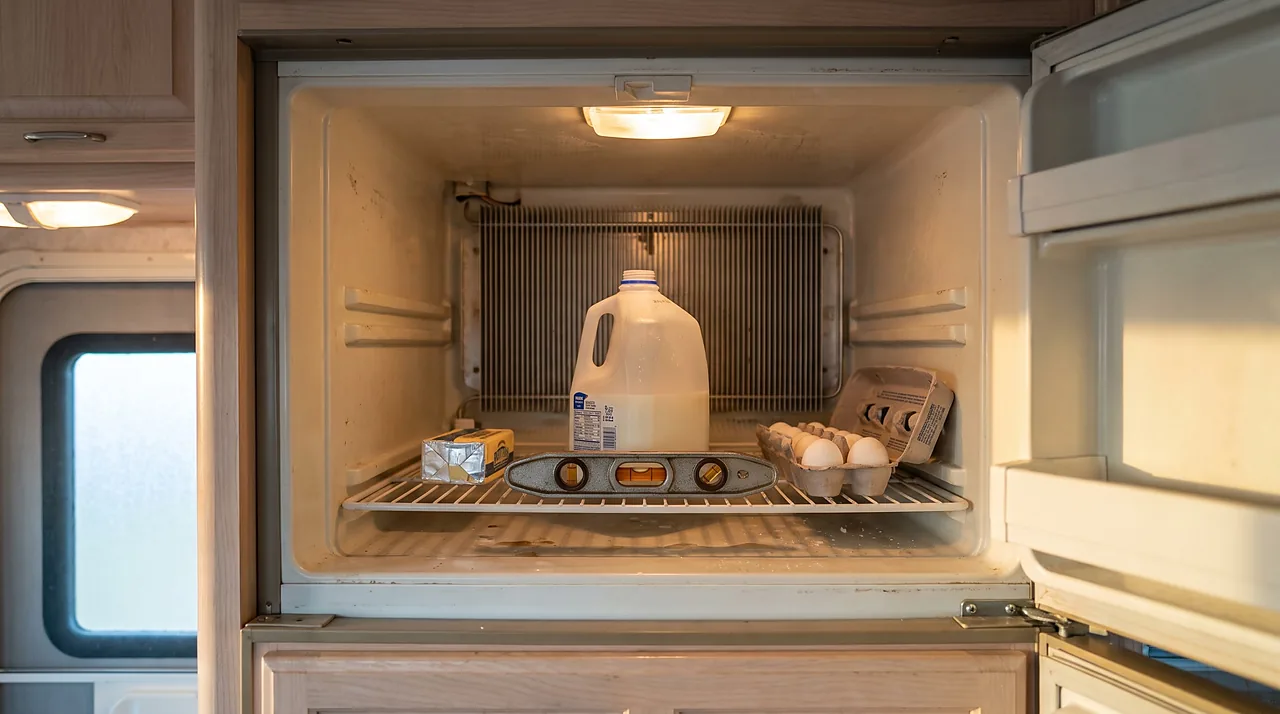
Warm milk and soft butter in an RV fridge almost never mean the compressor died, because there is no compressor. Absorption fridges (Dometic, Norcold, most factory units in travel trailers and fifth wheels) cool with a sealed loop of ammonia, water, and hydrogen that moves entirely by heat and gravity. Two things kill that process more than anything else: parking off level, and losing the heat source that drives the whole cycle. Check level first. It costs nothing and it is the single most common reason a perfectly good fridge stops holding temperature.
Why level matters to an absorption fridge
Inside the cooling unit, the evaporator tubing is pitched at a specific slope so liquid ammonia keeps flowing downward by gravity as it absorbs heat from the compartment. Park the rig even a few degrees out of level and that flow stalls in sections of tubing. Ammonia pools where it shouldn't. The cooling cycle loses efficiency, or it stops working altogether while you sit still. Run it that way for hours at a campsite and you risk more than a warm evening; you can shorten the life of the cooling unit itself.
Manufacturers publish a side-to-side and a front-to-back limit, a few degrees each, and the exact numbers differ by model, so check the manual; the habit matters more than the number: level the rig before you fill the fridge.
How to check level the right way
A bubble level clipped to the trailer tongue tells you the frame is level. It tells you nothing about the fridge itself, because floors settle, cabinets shift half a bubble, and the fridge box can sit slightly twisted in its cabinet cutout even on a rig that reads dead level at the hitch. Put a small torpedo level or a phone leveling app directly on a fridge shelf, in both directions, with the door shut as briefly as possible.

- Side to side: set the level across the shelf, left door jamb to right door jamb.
- Front to back: set it running from the door lip to the back wall of the compartment.
- Do both checks only after the leveling jacks or blocks are down and the rig has settled.
- Recheck after refueling, hitching, or any move that shifts weight, since a site that read level an hour ago can drift once tanks empty or fill.
If you're setting up on soft ground or a sloped pad, this is the same leveling work covered in getting a rig properly leveled and stabilized; the fridge is simply the appliance that punishes you fastest for skipping it.
Level checks out. Now split gas from electric.
Confirmed the rig is within tolerance and the fridge is still warm? The next fork in the road is the heat source. Gas failures and electric failures call for almost entirely separate repair paths, so this split matters. Three-way units run on 120V AC shore power, 12V DC, and LP gas. The 12V mode is usually only useful while the engine is running, since idle 12V operation drains the house battery in a matter of hours. Automatic models run on 120V AC when shore power is present and switch to gas when it is not; 12V DC is usually selected by hand and meant for driving.

That priority order explains a common complaint. An intermittent shore power connection or an undersized extension cord can quietly push the fridge onto gas without you noticing. A fridge that "worked fine on the way here" can go warm the moment you plug into a weak pedestal. Before assuming a burner or heating element is dead, force the fridge onto each mode manually. Most panels have a button per source. Watch which ones respond at all.
The gas-vs-electric decision fork
Work through this fork in order. Each step assumes the level check above is already confirmed; an off-level fridge can mimic every symptom below.
- Gate: Is the rig level (per the check above)? If not, level it, wait a few hours for the cooling unit to recover, and re-test before going further.
- Won't cool on any mode, level confirmed: suspect the door seal not sealing (or a door latch that let the door drift open in transit), or blocked vents. Check the door gasket first, then the roof and side vent grilles; see fridge venting and airflow.
- Won't cool on gas only, electric fine: suspect an empty cylinder, a closed gas valve, air in the line, or a dead igniter. Check the cylinder gauge, the shutoff valve, and the burner assembly.
- Won't cool on 120V AC only: suspect a tripped fuse, no shore power, or a failed AC heating element. Check the fridge fuse and the shore cord and pedestal; see house electrical basics.
- Won't cool on 12V DC only: suspect a blown 12V fuse, a weak house battery, or the engine not running. Check the 12V fuse panel and the battery's state of charge.
- Cools some, just not cold enough: suspect the thermostat set too low for the ambient heat, or crowded shelves blocking airflow. Check the thermostat dial and the clearance around the cooling fins. If the freezer is cold but the fridge section is warm, the cooling unit is working; look at airflow inside (overloaded shelves, a blocked fin area), the thermistor clipped to the fins, and a fin fan if fitted, before suspecting the cooling unit.
This fork reflects the manufacturer's own documented failure list for three-way units, which separately breaks out a defective burner, a defective cooling unit, and a defective heating element as distinct faults instead of one generic "won't cool" bucket. A bad burner assembly and a bad AC heating element call for completely separate repairs, so treat the split seriously.
Testing the burner
With the fridge switched to gas and the cylinder valve and inline shutoff open, most automatic-ignition units attempt to light, and if the flame doesn't catch, they retry a couple more times over a couple of minutes before flashing a fault code. If you smell gas at any point, that changes the whole procedure: shut the appliance off, open windows, do not operate any switch or flame nearby, and shut the cylinder valve if it is safe to reach. Never test for a gas leak with an open flame; a soapy-water test on the fittings is the safe way to look for bubbles. A burner that lights but the flame won't hold, or a unit that stays cold with the burner confirmed lit, usually points to the cooling unit itself rather than the gas train. That repair is a job for a qualified RV appliance technician.

Testing the electric elements
On AC, check the fridge's own fuse first. Then confirm the pedestal or shore connection is delivering full voltage, rather than a sagging voltage from an overloaded pedestal. On 12V DC, check the fuse at the panel and the battery's actual charge, since a fridge that only "half-works" on 12V is frequently a battery problem wearing a fridge costume. If fuses are good and voltage checks out on both sides but the compartment still won't warm past ambient, the heating element inside the fridge has likely failed. At that point it's a parts-and-labor repair. Stop chasing it with a multimeter in a parking lot.
Resetting the fridge and the "no AC" message
A reset is a power cycle: switch the fridge off at its panel, or pull its 12V fuse at the 12V fuse panel, wait a minute, and turn it back on so the control board restarts and retries ignition. A "no AC" or similar message means the fridge is not receiving 120V, so check shore power, the breaker and the fridge's AC fuse, or switch to gas while you sort it out. Codes differ by model, and the manual's code list is the reference for appliance fault codes.
What a heat wave really does to an absorption fridge
A fridge that runs noticeably warmer on a 100-degree afternoon than it did on a 75-degree morning can still be working correctly. Absorption cooling loses efficiency as the gap between inside and outside temperature shrinks. During a real heat wave, the fix is often simple: bump the thermostat to its coldest setting, park in shade, crack a roof vent over the fridge area if it has one, and give the unit a few extra hours to recover. That's often all it takes. Manufacturers document this drop in performance themselves as expected behavior in hot conditions. The real warning sign looks different: a fridge that stays warm even after a cool overnight low, or one that won't respond at all on a given power mode after the checks above.
One quirk worth knowing if you camp at elevation: gas ignition can get flaky at high elevation on some units, for purely physical reasons tied to combustion air. It's a known limitation, documented by the manufacturer itself. If the burner lights fine at low elevation and only misbehaves once you're up a mountain pass, altitude is the likely explanation.
One thing this piece does not cover: converting an absorption fridge to a residential compressor fridge. That's a different appliance, with its own electrical draw, its own cabinet cutout needs, and its own inverter sizing questions. It deserves its own dedicated treatment, separate from a cooling-fault guide.
Questions
What owners ask next
How long can an RV absorption fridge run off level before it's damaged?
There's no universal safe window. Manufacturers document degree limits, because damage depends on how far out of level the unit sits. Treat any period parked outside your model's published tolerance as a real risk. Level the rig before you start it up and load food.
Will an RV fridge cool while driving even if the campsite it's parked at isn't level?
Movement helps because the rig rocks through level repeatedly instead of sitting tilted in one direction, which is different from being parked motionless on a slope. It's still worth leveling for extended stops, since the fridge only truly needs to be level while stationary and running.
Can I run the fridge on propane while driving to save the house battery?
Check your owner's manual and local rules first. Shutting off propane appliances while fueling, on a ferry, or while a trailer is being transported is a standard LP-gas safety requirement under NFPA 58, and some states restrict driving on propane entirely.
The fridge smells like rotten eggs or ammonia near the back vent. Is that dangerous?
Yes, and the two smells mean different things. A rotten-egg smell is the odorant added to propane, so treat it as a gas leak: shut the gas off at the tank, open doors and windows, and do not operate switches or flames until the leak is found. Treat a strong ammonia-type odor as a possible cooling-unit leak: shut the fridge off, air out the area, avoid open flame or switches nearby, and get it inspected by a qualified technician rather than continuing to run it. Yellow powdery residue around the cooling unit at the back is the classic sign of a leak, along with the ammonia smell.
How long does an RV fridge last, and does it have a compressor?
An absorption fridge has no compressor. The cooling unit is the part that wears out, and running it level and well ventilated is what keeps it going. Residential-style compressor fridges in some rigs are a different appliance, where a compressor that runs constantly, clicks on and off without cooling, or is hot and noisy points to trouble.
Read next
Keep going on this system
Sources
What this guide is based on
- Dometic
- Thetford (Norcold)
- NFPA
Built from manufacturer manuals and published specifications. If something here does not match your appliance label or manual, the label and manual win.