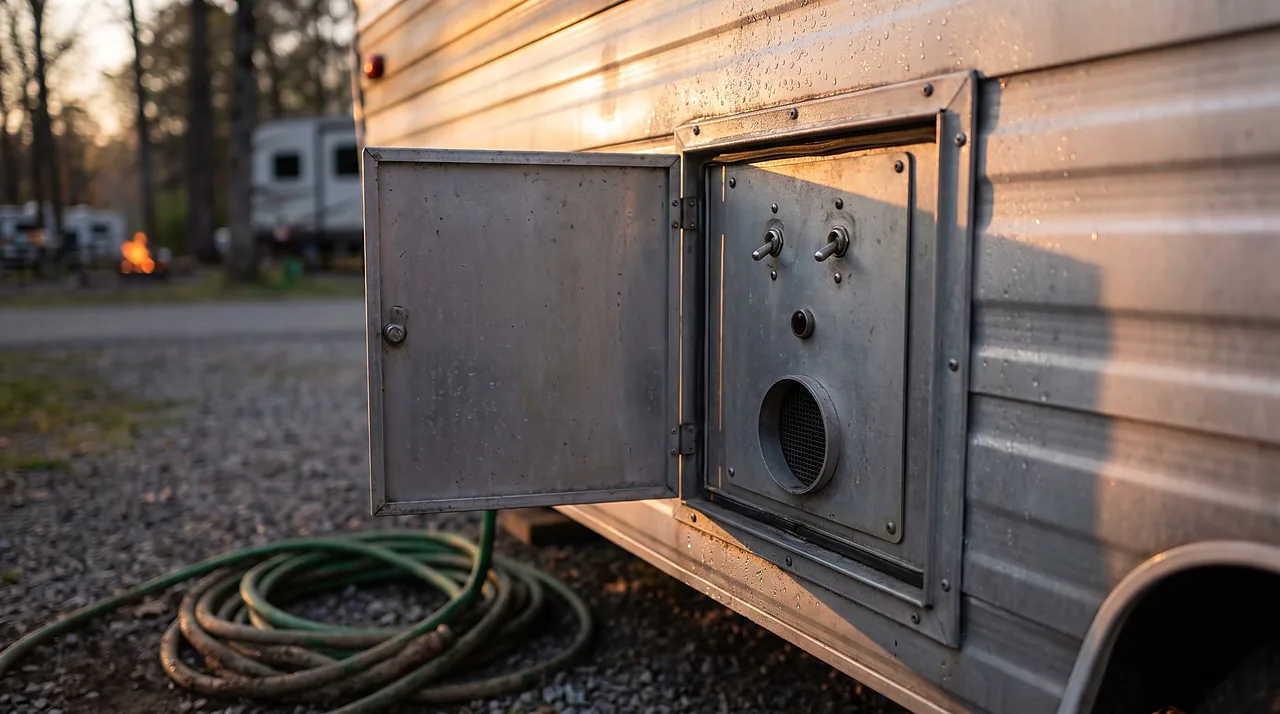
You turn the shower knob, wait for the warm water that never comes, and the campground office closed an hour ago. Before you touch a wrench, the fastest thing to figure out is which half of the water heater quit, because a gas-side failure, an electric-side failure, and a heater that is stone cold on both fuels point to three completely different repairs.
Most RV water heaters run two independent heating paths sharing one tank: a propane burner with direct spark ignition (DSI), and a 120V electric element that only works on shore power or generator. They fail separately most of the time. When both go cold at once, the cause is almost never "the water heater broke twice in one day." It is usually a shared part, most often the high-limit safety switch, or the water never reached the tank at all because a bypass valve is still turned to its winter position.
Start here: which side is actually dead
Work through this before opening any panel. Check the bypass valve first, every time, then branch by which fuel side the symptom points to, so you open the right access door on the first try.
Step 1: rule out the bypass valve and an empty tank first
If there is no hot water at any faucet, both switches are on, and the tank feels cold to the touch, stop here before checking anything else. Go straight to the three-way bypass valve behind the water heater. This single cause covers two separate scenes: a valve still parked in its winter position, which leaves the tank dry so neither fuel side has anything to heat, and a heater that worked fine on a prior trip but now shows nothing right after a dump-and-refill or a spring dewinterize, where the valve was left mid-position, an air lock formed in the line, or the drain plug or anode rod never went back in. Clear this step before assuming any part has actually failed.
Step 2: if the tank is filling normally, check which fuel side is affected
Electric only: the electric switch is on, the breaker looks fine, and water stays cold for hours. Most likely cause is a tripped 120V breaker, a dead thermostat, or a burned-out element. Look first at the shore power panel, then the element access door.
Gas only: the gas switch is on and you hear clicking but no whoomp, or nothing at all. Most likely cause is weak 12V DC, air in the LP line, a dirty or misgapped igniter, or a low LP tank. Look first at house battery voltage, then the burner chamber.
Both sides, with a fault light: both switches are on, a small fault light blinks or stays lit, and nothing heats. Most likely cause is the high-limit (ECO) safety switch tripped from a prior overheat. Look at the reset button behind the small cover plate on the tank face.
Both sides dead: check the bypass valve before anything else
This is the fault that eats the most time for the least reason. If the water heater ran fine in November and is stone cold now in May, the most likely reason is that the tank itself is empty because a three-way bypass valve is still parked in its winter position from whenever it was last dewinterized. In bypass, the valve routes water around the tank instead of into it, so the tank sits dry, the elements can scorch, and DSI simply has no water to heat.

Working out which port is open and which is closed on a bypass valve, and moving it back to normal running position without cross-threading a fitting, is its own small job with its own failure points, so it gets full treatment in the bypass valve walkthrough. The short version: get the valve back to normal (in-line) position, let the tank fill completely, open a hot tap until water runs steady with no air sputtering, then try ignition again. Running either heating element dry, even for a few minutes, is one of the fastest ways to kill it.
If you dewinterized recently and this is the first hot shower attempt since, back up one more step: a rushed spring dewinterizing pass commonly leaves a drain plug loose, an anode rod finger-tight, or the bypass valve half-turned, and any one of those alone will present as "water heater not working."
Gas side dead: DSI ignition path
Direct spark ignition needs three things at the same moment: 12V DC power, LP gas at the right pressure, and a clean spark at the electrode. Miss any one and the board will not light the burner, and most control boards will lock out after a handful of failed tries instead of sparking on and on.

- 12V power first. DSI boards are voltage-sensitive; check the water heater's DC fuse in the 12V fuse panel, and check house battery voltage while you're there. A weak battery reads fine on a cheap tester but sags under the ignition module's load.
- Gas supply second. Confirm the LP tank isn't empty, then bleed air from the line by lighting a stovetop burner first if the RV sat unused a while. Listen for the solenoid click when the switch goes on; no click at all usually points to a power problem at the valve itself.
- Pressure, if it still won't hold a flame. Suburban and Dometic both spec regulated LP pressure in inches of water column, tested with a manometer while other gas appliances run; eyeballing it isn't reliable. Dometic's maintenance guidance calls for gas pressure to be checked periodically and set to about 11 inches of water column with three appliances running. If your reading is off from that, hand it to a gas fitter as a regulator problem.
- Electrode last. A sooty, cracked, or misaligned electrode kills spark even with good power and gas. This is a visual and a gap check, and it's a quick fix once the access door is off.
Furnace igniters run on the same 12V system and get flaky for the same reason DSI water heaters do: a battery that reads acceptable at rest sags under load once the ignition module draws current. So if a furnace is also refusing to light this same trip, stop chasing the water heater specifically and go straight to the battery.
Electric side dead: the 120V element path
The electric side is simpler mechanically but depends entirely on shore power actually reaching the heater. Work outside-in: breaker, then thermostat, then element.

- Confirm the 120V breaker for the water heater hasn't tripped. On many Suburban units, the outside electric switch sits on the heater's own panel, where it is a small rocker switch easy to bump off during a wash.
- If the breaker's fine and the switch is on but nothing warms up after a full heating cycle, the internal thermostat or the element itself has likely failed. Elements read a specific resistance value when tested with the power fully off. That value differs by model and wattage, so pull the number from your unit's own data plate or parts manual first and compare your meter reading against it before replacing the element.
- A reading of infinite resistance (open) means the element burned out and needs replacement. A reading near zero means a short, and that heater should not be re-energized until it's replaced.
One more electric-side wrinkle worth knowing: if the campground pedestal itself is undersized or wired hot-neutral reversed, the water heater can read "dead" when the real fault sits upstream in the shore power connection, not in the appliance, so a quick check at the pedestal can save a wasted parts run. For isolated troubleshooting when the gas burner still works normally, see the dedicated guide on no hot water on electric.
Both switches on, nothing heats: the high-limit safety switch
Every RV tank water heater has a manual-reset high-limit switch, sometimes called the ECO, that is separate from the day-to-day thermostat and exists specifically to shut the whole unit down, both gas and electric, if the tank ever overheats. It is usually reached through the outside access door, near the thermostat and gas valve, and the exact spot varies by brand. Once it trips it stays tripped until someone physically resets it. This is why a genuinely overheated tank looks identical to a dead water heater from the outside: both switches are on, and nothing happens.

Dometic's guidance for clearing that lockout is to let the water cool, which can take up to half an hour, put the control switch off for 30 seconds, then switch it back on. If it trips again within a day or two of resetting, don't keep resetting it. A high-limit switch that keeps tripping is reporting a real overheat, most often a failed thermostat or a dry-fired element, and running it that way risks tank damage.
Anode rod: the mix-up that ruins one tank type and wastes money on the other
A cold tank isn't always a switch or ignition problem; sometimes it's slow corrosion catching up. Which fix applies depends entirely on what the tank is made of, and this is the single most common mix-up owners make. Suburban builds a porcelain-lined steel tank and sells a magnesium (or aluminum) replacement anode rod specifically for it, meant to corrode in place of the tank itself. Dometic and Atwood take the opposite approach: their tanks are aluminum construction, and Dometic states plainly that these units do not use an anode rod at all, because the tank material itself doesn't need one.
Hunting for an anode rod on an aluminum tank wastes money, and ignoring a steel tank's anode until it is eaten through ruins the tank. If you don't already know which one you have, that's worth settling before you troubleshoot anything else heat-related; the anode rod identification guide walks through telling the two apart from the fitting itself.
When it's not the water heater at all
A few campground scenes get blamed on the water heater that actually trace somewhere else entirely. The gas side of the water heater, the furnace, and a fridge that won't cool on gas all need 12V from the house battery, so several of them failing on one trip points to the battery. Meanwhile, the electric element, an AC that isn't cooling, and a fridge on electric all need shore power, so several of those struggling at once points to the pedestal or low campground voltage. Checking hookup power with a surge protector that shows voltage heads off chasing multiple appliance issues when the real fault sits upstream.
Frequently asked questions
What is the most common reason an RV water heater stops working?
The most common reasons are a bypass valve left in its winter position, a tripped high-limit reset switch, or an electrical switch, breaker, or fuse that is turned off. On the gas side, ignition failures usually stem from a weak house battery or air trapped in the LP line after storage. Always check those simple points before buying any replacement part.
Why does my water heater work on gas but not electric, or the other way around?
Because the two systems share a tank but almost nothing else. Gas uses 12V DC for ignition and LP for fuel; electric uses 120V AC and a resistive element. A fault on one side, a blown DC fuse, a tripped 120V breaker, a bad electrode, a dead element, rarely touches the other, so a heater that's half-working is telling you exactly which path to check.
How long should I wait before assuming the water heater is actually broken?
Give the tank a full heat cycle first; electric heats more slowly than gas. A heater that was recently drained, dewinterized, or bypassed also needs time to fully purge air from the line before it heats evenly. Run one complete cycle and check again before pulling any part.
Is it safe to keep resetting the high-limit switch myself?
A single trip right after an obvious cause, a spring dewinterize that ran the tank dry for a few seconds, a breaker flicker mid-cycle, resets clean and doesn't come back for months; that's the switch doing its job once. What's not normal is a second trip the same day, or a trip on two or three separate heating attempts within a week. At that point, stop resetting it yourself and get a tech to check the thermostat and element, since each reset after a genuine fault means the tank has already survived another overheat cycle.
Could a full campground's water pressure be the actual cause?
High incoming campground water pressure typically has no effect on ignition or heating. Over time, though, it can stress fittings and the pressure-temperature relief valve on the tank, and that kind of damage tends to show up later as a slow drip or a relief valve that won't reseat. Installing an inline pressure regulator at the hookup heads it off.
Read next
Keep going on this system
Sources
What this guide is based on
- Dometic Support, "How to clear a water heater over-heating failure"
- Dometic Support, "Maintenance and Care Instructions" (Water Heaters - Gas)
- Dometic Support, "Using After-Market Anode Rods"
- Suburban RV, "Advantage Water Heaters"
- Suburban RV, "Replacement Anode Rod" product page
Built from manufacturer manuals and published specifications. If something here does not match your appliance label or manual, the label and manual win.