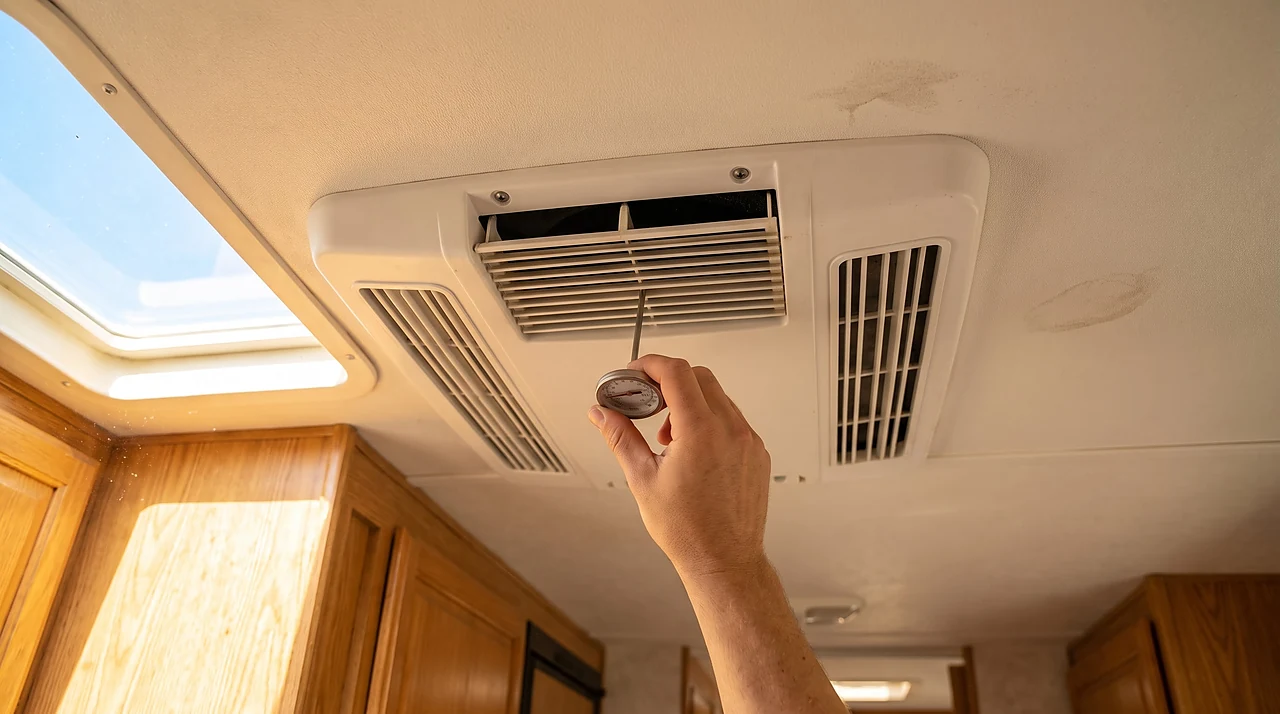
Put a thermometer at the return air grille, then one at the nearest supply vent, and read both while the compressor is running. That number, the gap between them, tells you more about your rooftop air conditioner than the thermostat setting ever will. A healthy unit produces a supply-air temperature roughly 16 to 22 degrees Fahrenheit below what it's pulling in at the filter, according to Coleman-Mach's own service guidance for its Mach air conditioners. It does not produce a specific room temperature, and on a 95-degree afternoon with the sun cooking a white fiberglass roof, that split is the real measure of whether the unit is doing its job.
Owners who expect a rooftop unit to knock a trailer down to 68 degrees on a heat-wave day are comparing it to a home central-air system with three or four times the capacity per square foot and a shaded, insulated attic above the ducts. A single 13,500 BTU rooftop AC working against a low-slung aluminum or fiberglass roof in direct sun has a harder job than most owners realize. A warm RV on a brutal day can still have a real, fixable problem underneath it. The first move is measuring the split rather than guessing at the thermostat.
Measure the split before you touch anything
Here's the method, and it takes about ten minutes:
- Run the AC on high fan and cool for at least 15 minutes so the system settles, doors and windows shut, no cooking or extra heat sources running.
- Hold a probe thermometer at the return air grille (usually the center of the ceiling assembly, where air gets pulled in) and note the temperature.
- Hold the same thermometer at the closest supply vent and note that temperature.
- Subtract. Supply temperature should read 16 to 22F cooler than return temperature.
A split inside that band means the compressor, coils, and refrigerant charge are working correctly, even if the trailer still feels warm on a brutal day. A split under about 14F with cold vents but a hot cabin usually means an undersized unit for the day's heat load, poor insulation, too much window glass in direct sun, or a second unit that needs to be running too. A split under 10F, or supply air that is barely cooler than return air, points to a mechanical problem: the compressor isn't pumping refrigerant the way it should, the coils are blocked, or the charge itself is compromised.
Work the checklist in this order: airflow, then coils, then capacitor, then charge
Chase the cheap, fast, DIY-safe causes before assuming the compressor or refrigerant charge is at fault.

1. Return air filters and airflow
Pull the return air grilles and look at the filters. A clogged filter starves the coil of airflow, and Coleman-Mach's own guidance names dirty filters directly as a freeze-up cause, noting that "an obstruction of this airflow will directly affect the performance of the unit." Wash foam filters in warm water, let them dry fully, and reinstall. Check that nothing (a folded bedspread, a stray sock, a closed interior vent) is blocking the ducted supply runs too. Restricted airflow on the low fan speed is worse than restricted airflow on high, since the same source notes that running the compressor and a low fan speed together can make an existing freeze-up accelerate.
The ceiling assembly has a divider (often foam) that keeps cold supply air separate from the return; if it has shifted, sagged or broken, cold air loops straight back into the return and the cabin never cools even though the vent air feels cold. With the power off, drop the ceiling grille and look for a gap or a displaced divider; ducted units can also lose air through a crushed or disconnected duct run.
2. A frozen or iced evaporator coil
Remove the return grille and look at the coil fins. A sheet of ice or heavy frost across them means the coil has iced over, usually from restricted airflow (see above), a low outdoor temperature the unit wasn't meant to run in, or a marginal refrigerant charge. Running cool mode against an iced coil deepens the ice and can push liquid refrigerant back to the compressor, which is a good way to shorten a compressor's life. Switch to fan-only on high speed instead and let the coil sit until it's fully clear, which can take twenty minutes to an hour depending on how much ice built up. Once the coil is clear, fix whatever caused the freeze (usually airflow) before running cool mode again.

3. The run capacitor
If the fan runs fine but the compressor never kicks on, or it hums for a few seconds and shuts back off on a hard trip, a weak start/run capacitor is one of the more common non-sealed-system failures in a rooftop unit. The capacitor stores a charge even with the unit unplugged, so this is a job for a qualified 12V/120V-comfortable tech rather than a first electrical repair; a shock from a bad discharge attempt is a real risk. Review the steps for testing and replacing the AC capacitor before opening any access covers.

4. Refrigerant charge, and where the DIY line sits
If airflow is clean, the coil isn't icing, and the capacitor tests fine, and the split still won't close, the remaining suspects live inside the sealed refrigerant circuit: a slow leak, a partially blocked metering device, or a failing compressor. This is where the job stops being a driveway fix. Rooftop RV air conditioners are built as closed, sealed systems that, as Coleman-Mach puts it, ideally should never need a recharge over their working life; refrigerant itself doesn't wear out or go stale sitting in the system. If the level is low, something let it out, and simply adding more without finding and repairing the leak just delays the same failure. On top of that, federal rules put a hard legal line here: EPA Section 608 requires certification for anyone attaching gauges, adding or removing refrigerant, or otherwise opening that circuit. A recharge is EPA 608-certified tech work: recovery equipment, gauges, and a leak-detection process, full stop.
Run your own split number through this triage, ranked by what it usually means
Once you've measured your own return and supply temperatures, use that number to rank the likely cause before opening anything up:
- Split under 10F, compressor and fan both running: this is the top suspect list, in order: blocked airflow, an iced coil, or a low refrigerant charge. Airflow and coil issues are owner-fixable; a low charge is not, since that circuit is EPA 608-certified work only.
- Ice sheet visible on the coil fins: almost always restricted return air, low fan speed use, or a marginal charge underneath it. A fan-high thaw plus a filter cleaning handles the airflow side; if ice keeps coming back after clean filters and high fan speed, the underlying charge needs a certified tech, not another thaw cycle.
- Fan runs, compressor stays silent or trips off repeatedly: points to a failed capacitor or a compressor thermal overload. You can diagnose which one from the timing pattern described below, but the capacitor swap itself is best left to a tech given the stored charge.
- Split reads 16-22F at the vent, cabin still feels hot: the unit itself is very likely fine. Look instead at an undersized unit for the heat load, sun exposure, thin insulation, or venting. Shades, extra venting, or a second AC unit move this number more than any repair does.
- Warm air, a low hum, no cool air at any point: the most serious end of the list, usually a compressor failure or a major refrigerant loss. This one needs a certified tech from the start.
That ranked list is the fast triage pass. It works best paired with the thermometer reading from the split test above, not as a substitute for it.
Resetting the AC (most units have no reset button)
Rooftop units rarely have a reset button. The reset is turning the AC off at the thermostat, switching off its breaker for a minute or two so the control board restarts, then turning it back on. Expect a delay of a few minutes before the compressor starts, which protects it after a power cut. If the thermostat shows a code, that thermostat's manual lists it, or you can check appliance fault codes and resets.
Where the campsite power supply fits in
A rooftop AC pulling a hard start current on compressor kickoff is one of the bigger loads in an RV's electrical system, and a marginal shore power connection can produce symptoms that mimic a mechanical problem: a compressor that struggles to start, trips a breaker, or runs weak on a hot pedestal circuit shared with half the campground. Before assuming the unit itself is failing, it's worth knowing what your 30-amp versus 50-amp service actually delivers in watts and whether the pedestal is holding voltage under that startup load. Using a surge protector that shows pedestal voltage helps catch campground voltage sag before assuming the rooftop unit has failed. A unit fighting low voltage will run hotter, cycle oddly, and wear its start components faster, all without anything actually being broken inside the AC.
Keeping it from happening again
Most freeze-ups and airflow problems are preventable with the kind of routine attention that belongs on a seasonal walk-through rather than a heat-wave emergency call. Cleaning return filters every couple of weeks in regular use, keeping supply vents unobstructed, and giving the unit a look before the first hot stretch of the season all belong on a broader running maintenance checklist that covers the systems most owners forget until something quits. An AC that gets a five-minute filter check every other week rarely shows up frozen on the one weekend it's 95 degrees outside.
What a healthy unit cannot do
Even a perfectly maintained rooftop AC, hitting a full 22F split, will struggle to hold a trailer at 72 degrees when it's 100 outside with the sun directly on the roof and the awning not deployed for shade. That is not a defect. It is the physics of a compact rooftop compressor against a small insulated box baking in direct sun. A second AC unit, reflective roof coating, window shades, and simply parking with the worst-exposed side away from the sun all move the needle more than chasing a phantom mechanical fault on a unit that is already delivering its rated split.
Questions
What owners ask next
Do I need a fancy thermometer to check the split, and does humidity throw the number off?
A basic probe or dial thermometer is accurate enough, since you're measuring a difference between two readings rather than an exact calibrated temperature. Humidity matters more than most owners expect: on a muggy day the coil spends part of its capacity wringing moisture out of the air, so a correctly working unit can show a split a couple of degrees smaller than it would on a dry day. If you're testing right after a storm or on a coastal, high-humidity trip, don't treat a split near the low end of the 16-22F band as a red flag. Recheck on a drier day before assuming something's wrong.
Can I recharge my RV air conditioner myself if the split is low?
No. Rooftop units are sealed refrigerant systems, and federal EPA Section 608 rules require certification to attach gauges or add or remove refrigerant. A low charge also means a leak somewhere, so a recharge without finding that leak just buys a few weeks before the same symptom returns.
How can I tell a bad capacitor from a tripped thermal overload without opening the panel?
Time and listen to what the compressor does on repeat attempts. A failing capacitor tends to hum for a second or two on every single call for cool, then cut out the same way each time, since the fault doesn't change from one cycle to the next. A tripped thermal overload behaves differently: the compressor may run for a while, cut out on protection, and then refuse to restart at all for several minutes while the overload cools and resets, running fine again once it does. If the compressor won't even attempt a restart for ten to fifteen minutes after cutting out, suspect an overload trip, often triggered by low shore-power voltage or high head pressure, rather than the capacitor. Either way, a mobile tech visit to diagnose costs far less than guessing wrong and swapping a good compressor.
Why does my AC ice up every time I run it on low fan speed?
Low fan speed moves less air across the evaporator coil, and running the compressor against that reduced airflow lets frost build faster than it can shed. A dirty filter narrows that airflow further. Clean the filters, run high fan speed in hot, humid conditions, and let any existing ice fully clear on fan-only before resuming cool mode.
The AC is not blowing any air at all. What now?
Having no fan at all is an electrical issue, not a refrigerant problem. Check the AC breaker in the main panel and the 12V fuse that powers the thermostat, then verify the thermostat settings and replace its batteries if it uses them. If the controls are receiving power, inspect the fan motor and the control board; a fan that hums without turning often points to the capacitor.
Read next
Keep going on this system
Sources
What this guide is based on
- Coleman-Mach (Airxcel) Service & Support FAQ
- US EPA, Section 608 Technician Certification Requirements
Built from manufacturer manuals and published specifications. If something here does not match your appliance label or manual, the label and manual win.