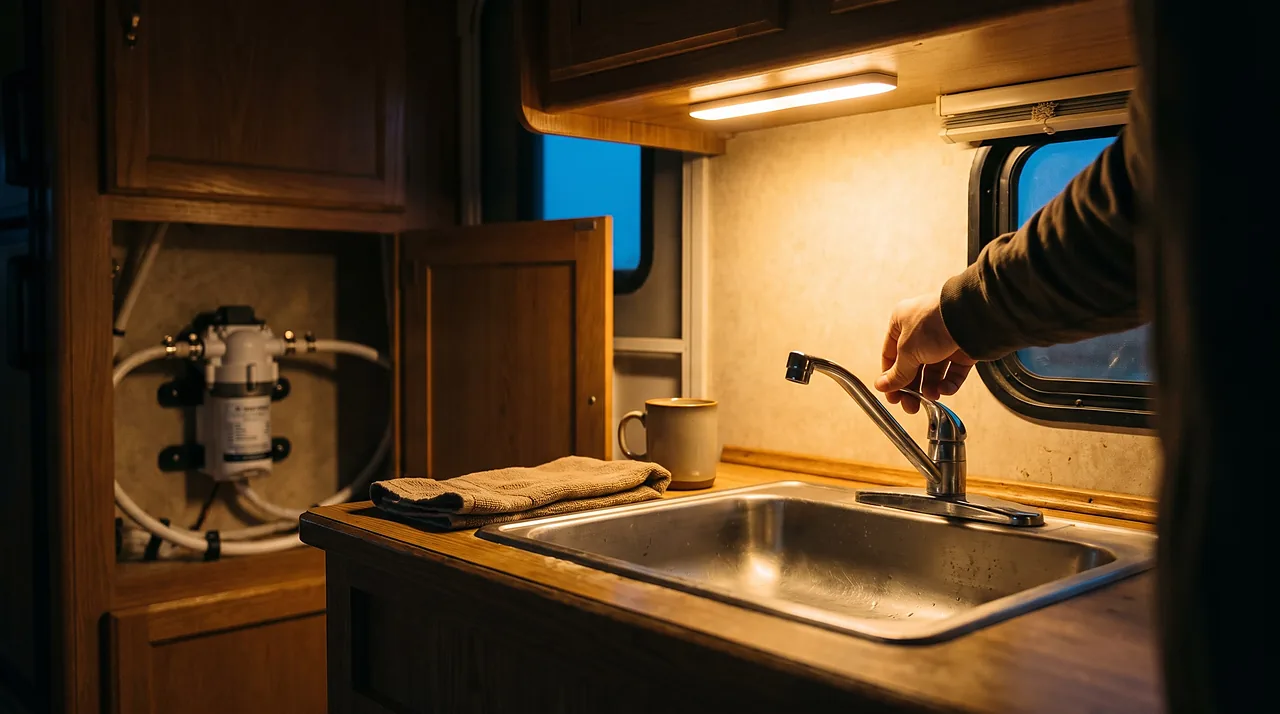
Start with the fresh tank, not the pump. Most "dead pump" calls at a campsite turn out to be an empty or partly isolated tank, and that check costs nothing and takes thirty seconds. Work the five causes below in this order: tank level and airlock first, then the fuse or breaker, then the inlet strainer, then the check valve, then the pump's internal diaphragm and valves. The early checks are the quick, free ones, so there is no reason to pull the pump apart before you have ruled out a dry line.
One thing to settle before anything else: is the pump silent, or is it running (humming, clicking, or rapidly cycling) but still not delivering water at the faucet? If it is cycling on and off while water actually comes out, even in short pulses, that points to a pressure-switch or air-charge problem with a different fix. Go read what a pulsing pump usually means instead of working through this list.
1. Check the tank level and rule out an airlock (most likely)
Look at the tank gauge, then confirm it by opening the fill cap and looking in, because gauges drift and lie. A pump with no water at its inlet will run dry-sounding and loud, or simply hum without moving anything.
Owners running two fresh tanks (a common setup on fifth wheels and larger trailers) hit this specific failure often: the selector valve gets left on the tank that is empty, or half-turned between positions so it draws air from both. If your rig has a tank-select valve, cycle it fully to one tank, confirmed full, and try the pump again. A pump that lost its prime to air in the line will often need a few seconds of running with a faucet open to re-seat suction; if it never picks up, work down the list.
Right after winterizing or dewinterizing the RV, check the pump's winterizing valve (the one that lets it draw antifreeze through a short hose). If it is still set to the hose, the pump pulls air or the dregs of a jug instead of tank water; turn it back to the tank.
Genuinely dry for the night, with no fresh water at all? That is a supply problem, and the fastest real water is hooking to a city water connection if the pedestal has one, which bypasses the pump and tank entirely while you sort out the rest.
2. Check the fuse, the breaker, and battery voltage
A demand pump draws real current, and it protects that circuit with a fuse or a resettable breaker sized to the pump. Ratings differ by model. Shurflo's technical data sheet for its 4048 high-flow pump calls for 14-gauge wire on the positive lead and a 15-amp fuse, while smaller 12-volt low-flow pumps from the same maker are typically fused at 7 to 10 amps; always match the fuse to the number printed on your own pump's label rather than a number from a different model.

Find the pump's fuse, usually in the 12-volt fuse panel or spliced inline near the pump itself, and check it with a multimeter or simply swap in a same-rated spare. If the fuse is good, check the house battery voltage at the panel: a pump that clicks but never spins, or a furnace igniter that also stopped firing the same night, points to a battery sagging well below 12 volts as the likely cause. A dead-silent pump with a good fuse and healthy voltage usually means the wire has come loose at the pump itself or at a connector, which is worth a visual check before assuming the motor died. Most RV water pumps have no reset button of their own; "reset" means a tripped breaker or a blown fuse feeding the pump. If you keep tripping this circuit, it is worth reading through how the pump's fuse and reset behavior actually work rather than swapping fuses at random.
3. Pull and inspect the inlet strainer
Nearly every 12-volt RV demand pump has a small in-line strainer screen just ahead of the pump inlet, sometimes built into a clear bowl, sometimes a simple screen fitting. Sediment, tank sealant flakes, and the odd bit of debris from a fill hose collect there over a season, and a fully clogged screen starves the pump exactly like an empty tank does: same humming, same no-flow result. A manufacturer troubleshooting reference from Shurflo lists a clogged tank strainer against noise, lost prime, and low-flow symptoms, which is the same failure pattern owners describe as "pump runs but nothing comes out."

Shut off power to the pump, unscrew the strainer housing (a small pan underneath catches the drip), rinse the screen under a hose or sink, and reseat it with the housing o-ring seated square, not pinched. If you have never located this part on your rig, this is a fair time to also get familiar with the rest of the fresh water system layout so you know where the tank, pump, strainer, and lines actually run.
4. Check the pump's check valve
The check valve keeps water moving one direction through the pump and stops it from draining back to the tank between cycles. A valve that has gone stiff with mineral scale, or has debris caught in the seat, can block flow outright or let the pump spin without building pressure. The same Shurflo reference lists a dirty or worn check valve as a cause across four separate symptoms, including a pump that will not start moving water and one that loses prime repeatedly.

Most demand pumps have the check valve built into the pump head or a nearby fitting rather than as a separate serviceable part, so this step usually means pulling the pump head cover (with power off and the line depressurized) and looking for a valve that will not seat, or ordering the specific rebuild kit for your pump model rather than guessing at a universal part.
5. Suspect the diaphragm and internal valves last
If the tank is full, the strainer is clean, the check valve moves freely, and power and voltage both check out, the remaining likely cause is wear inside the pump itself: a torn or pinched main diaphragm, worn pump valves, or a failing drive assembly. A manufacturer troubleshooting chart lists these as the cause behind persistent low flow and a pump that will not shut off cleanly, and none of them are a same-night roadside fix. Most demand pumps in this class cost less to replace outright than to source a full rebuild kit and reseal correctly, so a technician will usually quote a replacement pump once the first four checks come back clean.
Quick triage: work through these five in order
- Dead silent, no sound at all. Likely cause: a blown fuse, a tripped breaker, or a dead wire. Two-minute check: look at the 12V fuse panel or the inline fuse, then read battery voltage. Tonight's fix: swap in a same-rated fuse, or charge or swap the battery.
- Pump hums or runs loud, no water at the faucet. Likely cause: an empty tank, the wrong tank selected, or an airlock. Two-minute check: read the tank gauge, confirm at the fill cap, and check the tank-select valve position. Tonight's fix: confirm a full tank, cycle the valve to it, and run the faucet to reprime.
- Pump runs, only a weak trickle. Likely cause: a clogged strainer or a worn check valve. Two-minute check: pull the strainer screen and look at the check valve seat. Tonight's fix: rinse the strainer, or inspect and replace the check valve.
- Pump was fine, then suddenly dead after storage. Likely cause: a corroded fuse holder or a wire loosened during winterizing. Two-minute check: look at the wire connections at the pump and the fuse holder for corrosion. Tonight's fix: clean and reseat the connections, or replace a corroded fuse holder.
- Pump runs and pulses, and water does come out. This one is not on the dead-pump list at all. It points to a pressure switch or accumulator issue, the topic covered in the pulsing-pump article linked above.
What to do if none of this fixes it
If you have confirmed a full tank, a clean strainer, a free-moving check valve, a good fuse, and healthy battery voltage, and the pump still will not deliver water, the sensible next step is a replacement pump, since more guessing in the dark at a campsite will not fix worn internals. Note the model and flow rating off the old pump's label before you buy, since fittings and mounting footprints vary between brands even at the same flow rate.
Frequently asked questions
Why is my RV water pump running but no water is coming out?
Before working through the tank and strainer checks, try one sequencing trick: open the faucet first, then switch the pump on, rather than the other way around. Starting with the faucet already open gives trapped air a path out the instant the pump builds any suction, instead of the pump fighting a closed line for the first few seconds. If that alone does not clear it, move to confirming the tank is actually full and the strainer is clear.
How do I know if my RV water pump fuse is blown?
A fully blown fuse gives you a completely silent pump, no hum or click at all, when the switch is on. A corroded or partly loose fuse holder behaves differently: the pump may click weakly, cycle slowly, or run with noticeably less force than normal, because current is still getting through the connection, just at a reduced level. That distinction is worth noting before you pull the fuse: a scorched or greenish holder points to a wiring fix, a repair that goes beyond simply swapping the fuse.
Can a low battery stop the water pump from working?
Yes. For the most reliable reading, check voltage directly at the battery terminals, since the interior panel display is only a secondary reading. Panel readouts run through wiring, connectors, and sometimes a converter tap, all of which introduce a voltage drop that can mask how far the battery has actually sagged. If the terminal reading is noticeably lower than the panel reading, corroded or loose battery cable connections are worth checking too.
Should I replace or rebuild a worn RV water pump?
Cost parity is only part of the decision. Generic rebuild kits typically replace the diaphragm and valves but not the motor's drive bearing, so if the pump shows both low flow and a rough or grinding sound at the motor, a rebuild will not fully resolve it. A full replacement sidesteps that gap entirely, which is another reason it is usually the more practical call once the tank, strainer, check valve, fuse, and voltage have all checked out clean.
Why does my RV water pump turn on by itself with every faucet closed?
The pump runs whenever line pressure drops, so a short run every so often with nothing open means pressure is leaking away: a dripping faucet, a toilet valve that weeps, a loose fitting, or a worn check valve letting water slip back; find the drip before replacing the pump. Focus on finding a hidden water leak to locate the loss, and if the pump cycles rapidly while a faucet is running, read what a pulsing pump usually means.
Read next
Keep going on this system
Sources
What this guide is based on
- Pentair / Shurflo Pump Troubleshooting Guide
- Shurflo 4048 High Flow RV Fresh Water Pump Technical Data Sheet
- Shurflo 12-volt low-flow demand pump series data sheets (4008-101, 4009-101, 4008-131)
Built from manufacturer manuals and published specifications. If something here does not match your appliance label or manual, the label and manual win.