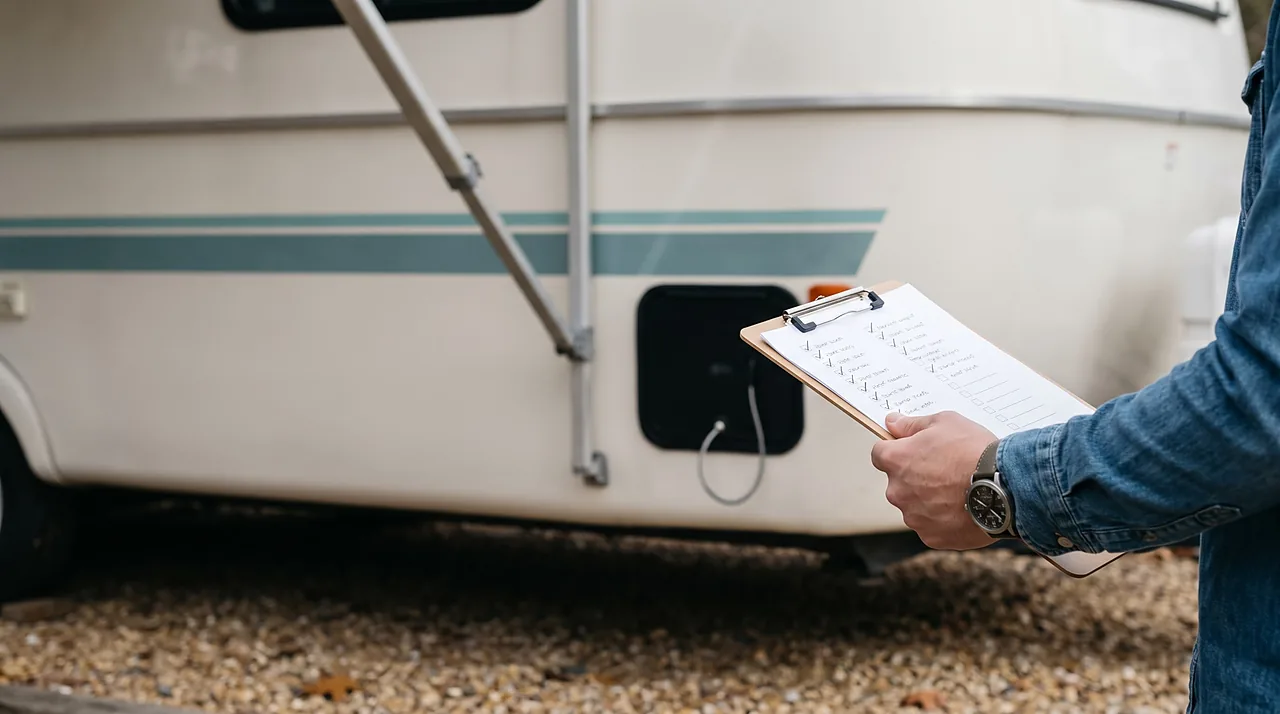
Twenty minutes a month and one focused day per season is the whole job. That is not a sales pitch to make maintenance sound easier than it is. It is roughly what the tasks below actually take, once you know what you are looking at. Most of the damage that turns into a real repair bill starts small: a soft floor under a slide, a ruined water heater tank, a dead house battery bank at the worst possible campground. Almost none of it happens overnight. It builds up over a year of something small getting skipped.
This page is a schedule. It tells you what to do and when, and each task links out to the page that actually walks you through doing it. A checklist that also tries to teach roof sealant chemistry or black tank sensor cleaning in the same breath ends up doing neither well. Print this, tape it inside a cabinet, and treat the deep-dive links as the reference you open when a specific task is actually in front of you.
Why a cadence-based checklist beats a task dump
A wall of forty unordered tasks is how good intentions die. Some jobs matter every time you use the rig (checking tire pressure before a trip), some matter on a calendar (dumping the black tank before it hits capacity), and some matter only twice a year (a full roof inspection). Sorting by cadence, not by system, means you are never staring at a 90-item spring list wondering where to start.
The other reason to sort this way: neglect compounds. A pressure regulator you meant to buy "eventually" does nothing while it sits on the shopping list. For eight months, campground pressure spikes well above the roughly 60 psi the plumbing is rated for slowly stress a fitting. A roof seam you'll "get to" behaves the same way. A hairline crack takes on water for two seasons before a soft spot shows up inside. None of these are one-time failures. They are slow ones, and a monthly rhythm is what catches them while they are still a five-dollar fix.
Before every trip (about ten minutes)
- Tire pressure checked cold and sidewalls looked at (tire care)
- Lug nuts snug
- Running lights, brake lights, turn signals and the breakaway cable on a trailer
- Smoke, CO and LP detectors tested (a propane detector that beeps)
- Roof vents, windows and the TV antenna down or closed
- Slide rooms clear on top and fully in
- Steps retracted and the awning locked
Monthly checklist (about 20 minutes)
| Task | What you're checking for | Where it lives |
|---|---|---|
| Run the water pump and check for pulsing or short-cycling | A pump that cycles on and off under a steady tap usually means a failing pressure switch or a waterlogged accumulator tank | pump pulsing fixes |
| Check the pressure regulator is still installed and the gauge (if it has one) reads in range | Regulate incoming pressure to 40-50 psi at the spigot; RV plumbing is commonly rated to 60 psi max, and a missing or failed regulator is a silent way to blow a fitting | setting the regulator |
| Look at the black tank level and dump before it's more than about two-thirds full | Waiting too long lets solids stack up on a closed valve instead of flushing clean; that stacking is the single most common rookie tank failure | black tank routine |
| Glance at tank sensor readings against what you actually know is in the tank | A sensor reading full when the tank is empty is almost always residue built up on the sensor plate | tank sensors that misread |
| Check house battery voltage at rest | Catches a slow parasitic draw or a converter that has quietly stopped topping off the batteries before it strands you | converter not charging |
| Test the propane detector and check for the furnace igniting on the first or second try | A furnace that struggles to fire often points back to low battery voltage rather than the furnace itself | furnace won't ignite |
| Run the slide out and back in while listening for grinding or hesitation | Catches a dry rail or a misaligned track before it becomes a slide that won't move at all | slide-out care |
| Extend the awning partway and look at the fabric for mold spotting | Mold caught early wipes off; mold left for a season can stain permanently | awning care |
| Clean the AC return-air filters | Clogged filters cut airflow and are the first thing to rule out when cooling drops | AC maintenance |
None of that requires tools beyond a flashlight and, for the battery check, a cheap multimeter. If any single item takes more than a couple of minutes, that's the signal to open the deeper page for that system instead of digging further on your own.

Seasonal checklist (one focused day, three or four times a year)
Seasonal work is where the calendar actually matters, because two of these four windows are non-negotiable if you live somewhere the temperature drops below freezing.
Spring (de-winterizing and the first full walkaround)
- Flush the antifreeze out of the water system and sanitize the fresh tank before the first trip
- Reconnect the water heater bypass valve to normal flow and refill the tank
- Do a full roof walk (in soft-soled shoes, only if the roof and ladder are rated for foot traffic) and check every seam, vent, and skylight for cracked or lifting sealant (the sealant inspection that should happen about every 6 months)
- Check tire pressure cold and inspect sidewalls for cracking after months of sitting
- Inspect the awning fabric and roller for winter damage before the first extension
The de-winterizing side of this has enough steps and gotchas that it gets its own page: the de-winterizing steps.
Summer (the heavy-use season)
- Recheck the roof at the midpoint of the season, since sealant works hardest under summer UV
- Watch AC performance on the hottest days; reduced cooling on an extremely hot day can be normal design behavior for the unit rather than a fault
- Confirm the absorption fridge is running level; hours of off-level operation can overheat the boiler section, crystallizing the rust inhibitor in the cooling solution and blocking tubing there, a failure that usually means replacing the cooling unit
- Add holding tank treatment on your normal cadence if you're using one
Fall (pre-storage prep for anywhere freezing is coming)
- Winterize the fresh water system: bypass the water heater first, which saves refilling a 6- or 10-gallon tank with antifreeze you'd just have to flush out again
- Use RV/marine antifreeze only, which is propylene glycol and pink; automotive antifreeze is ethylene glycol, green, and toxic, and it never belongs in a potable water system
- If using the blowout method instead of antifreeze, keep the air at 35-40 psi at most; higher pressure risks damaging fittings, pipes, and valves
- Clean and inspect the roof one more time before the rig sits (the sealant inspection that should happen about every 6 months)
- Dry-lubricate slide rails and awning arm pivots, never WD-40, which attracts grit
The full winterizing walkthrough, including the antifreeze-versus-blowout decision, lives at the winterizing guide.

Winter (storage checks, even if the rig isn't moving)
- Check on the rig periodically if it's stored somewhere reachable; a slow leak in a heated aisle or garage-kept unit can still do damage over a stored winter
- Verify the water heater bypass and tank drains are still in their winterized position
- Keep the propane detector's battery backup fresh if the unit has one
Annual checklist (once a year, regardless of season)
| Task | Why once a year is enough | Where it lives |
|---|---|---|
| Inspect the Suburban steel-tank water heater anode rod and replace it when worn (skip this on Atwood or Dometic aluminum tanks, which do not use one) | The rod corrodes so the tank does not; once it is worn down, the tank is next. | anode rod check |
| Full roof sealant inspection with a hands-on check of every seam, applying pressure to feel for soft or lifting spots | The 6-month visual checks catch obvious cracks; once a year, press along every seam by hand to find soft or lifting spots a glance misses. | roof maintenance |
| Check and reset torque on slide-out and stabilizer jack mounting hardware | Vibration over a year of towing or driving loosens bolts that don't show any symptom until they fail | slide-out care |
| Test the surge protector or EMS unit's own diagnostic function, separate from the outlet it plugs into | The protector only helps if it still works; most units show a status or fault light, so confirm it reads normal at a known-good pedestal. | surge protectors |
| Inspect and, if needed, replace toilet seals and valve seals | Seals dry out slowly over a year of intermittent use, especially in a rig stored part of the year | toilet seals |
| Deep-clean the grey and black tanks with a full flush-system pass | A once-a-year flush clears buildup that routine dumping alone leaves behind | black tank routine |
A simple way to build your own cadence if this doesn't fit your rig
Not every rig matches this list exactly. A rig used every weekend needs the monthly items closer to every two or three weeks; a rig stored nine months of the year can compress the seasonal list into two visits instead of four. Use this three-question method to build your own version instead of forcing the printed schedule onto a use pattern it wasn't written for.

- How many nights a month does the rig actually get used? Fewer than four nights a month: keep the checklist as written. More than ten nights a month, especially full-timing: cut the monthly interval in half. Tanks fill faster and systems cycle more when the rig is lived in.
- Does the rig ever sit through a freeze? If yes, the fall winterizing and spring de-winterizing steps are required every year. If the rig lives somewhere that never sees a hard freeze, those two steps shrink to a lighter seasonal check instead of a full winterizing pass.
- Is this the first year with this specific rig? First-year owners should run the monthly list at double frequency for the first three months. That's the window when a marginal water heater fitting, a weak factory sealant bead, or a battery already near end of life tends to reveal itself.
That third point matters more than it sounds like it should. A surprising share of expensive early failures aren't age-related wear at all. They're factory or dealer-prep issues instead: a fitting never fully tightened, a sealant bead skipped at one seam. First-year attention catches those before they become a mid-trip problem. The first-year RV mistakes page covers the pattern in more depth if this is a new-to-you rig.
What this checklist deliberately leaves out
This page stays inside onboard systems: water, tanks, electrical, propane appliances, roof, slides, and awnings. It does not cover engine service, chassis lubrication, towing hitch inspection, or brake maintenance, because those are a different discipline with their own manufacturer schedules, and folding them in here would make this list too long to actually use. If a water heater isn't producing hot water at all rather than just needing its yearly anode check, that's a different problem with its own troubleshooting path at a water heater that won't heat.
Questions
What owners ask next
How often should I actually winterize if I live somewhere mild?
If overnight temperatures never drop to freezing where the rig sits, a full winterizing pass isn't required. Still bypass and check the water heater and inspect the roof at the same time of year for consistency, but skip the antifreeze or blowout step entirely.
Can I skip the anode rod check if I have a Dometic or Atwood water heater?
Yes, and you can tell which type you have without opening the manual: pull the drain plug at the bottom of the tank. A hex-head metal rod means a steel Suburban tank that needs the yearly anode check. A plastic plug with no metal rod attached means an aluminum Dometic or Atwood tank, which never takes one. Those tanks are not built for a rod, so buying one is wasted money; check the heater's manual before changing the plug.
My rig sits in storage nine months a year. Do I still need the monthly checks?
Compress them into your two or three actual-use visits instead of doing them monthly. The items that matter most during long storage are the water heater bypass position, propane detector battery, and a look for any new leak or pest entry point.
Is a printable version of this checklist available?
The table format above is built to print cleanly from any browser's print function; there's no separate download, since the linked deep-dive pages are where the actual instructions live and a static printout would go stale as those pages update.
What is the 10 year rule for RVs?
Some private campgrounds and resorts limit or refuse rigs older than about 10 years, usually judged by appearance and condition. A clean, maintained rig with service records is the best answer, and policies vary by park, so ask when booking.
What is the 3-3-3 rule for campers?
It is a travel pacing habit, not a maintenance rule: drive no more than about 300 miles a day, arrive by 3 p.m., and stay at least 3 days. Arriving in daylight also leaves time to level, hook up and look the rig over before dark.
What should a new or new-to-you RV inspection include?
Run every system once on the first weekend: water under pressure with no drips, both dump valves, battery and converter charging, furnace, water heater on both fuels, fridge on both modes, roof sealant, slides and awning. Follow the first checks on a new-to-you RV and review first-year RV mistakes to catch early issues.
Read next
Keep going on this system
Sources
What this guide is based on
- Dometic Support
- Camco
- Dicor Products
- Progressive Industries
- Dometic
- RV Doctor
- Quincy Compressor
- Dicor Products
Built from manufacturer manuals and published specifications. If something here does not match your appliance label or manual, the label and manual win.