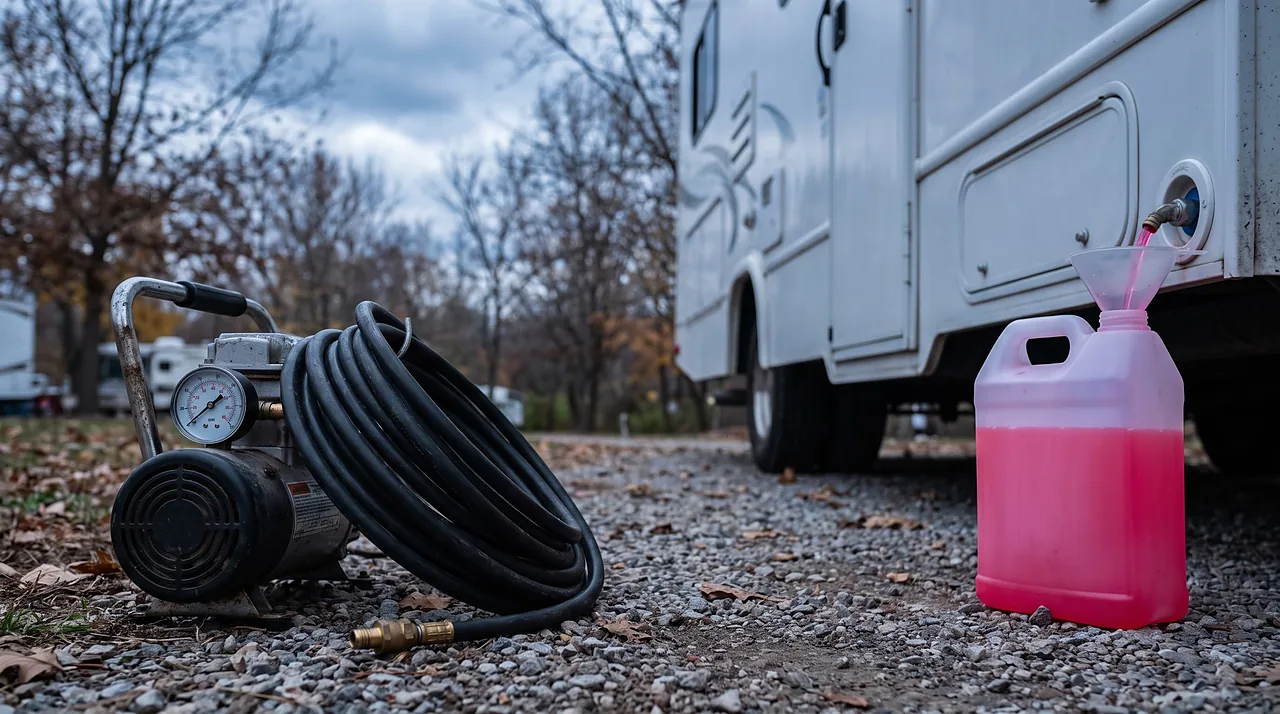
It's late October and the forecast just flipped to a hard freeze overnight. You're standing at the city water inlet with a jug of pink antifreeze in one hand and a spare air compressor fitting in the other. Both work. Neither choice is wrong. What decides it is where your low points sit, how much pink taste in the spring lines you can live with, and one step almost everyone skips that quietly decides how many gallons of antifreeze you end up buying.
This is the whole job in miniature: get every trace of water out of a system that will sit below freezing for months, without cracking a fitting, splitting a low-point drain, or leaving a pocket of water in a spot neither method reliably reaches on its own.
Air or antifreeze: what the decision actually hinges on
Compressed air pushes standing water out of the lines using pressure alone. Antifreeze physically occupies the lines, so anything that's still liquid inside them is protected even if a pocket didn't fully drain. Neither claim is close to controversial among techs who do this every fall. What separates a clean winterization from a spring repair bill is whether the method matches the plumbing layout in front of you.
A single-axle travel trailer with a simple, mostly-straight run of PEX and two low-point drains is a good air-blowout candidate: a compressor and a blowout plug clear it completely. A fifth wheel with a looping bathroom bay, an ice maker line, a washer hookup, and a low point that sags below the frame rail in one spot is a different animal. Air finds the path of least resistance and can leave a sag point wet while the rest of the line reads bone dry. Antifreeze doesn't care about the sag; it fills the whole run, low spots included.
Taste is the other half of the tradeoff. Antifreeze means running every faucet in the spring until the fluid clears, and city water at the campground will carry a faint sweetness for the first few gallons no matter how thorough that flush is. Air-blown lines have nothing to flush, because nothing but air went through them. If you hate the pink-water spring ritual and your rig's low points are simple, air wins on convenience. If your layout has sags, loops, or an ice maker you'd rather not gamble on, antifreeze wins on coverage.
The compressed-air blowout method, step by step
Start by fully draining the tanks and lines, well beyond just running the faucets dry. Open the low-point drains (usually a pair of small valves under the belly, one for hot and one for cold), open every interior faucet including the shower, and let gravity finish what the pump already started. Run the pump briefly with the faucets open to clear the last of what's in the pump housing, then shut the pump off and its breaker.

Thread a blowout plug into the city water inlet and connect an air compressor. Set the regulator to no more than 35-40 psi, and start lower if a fitting looks old. RV plumbing isn't built for shop-air pressures, and pushing much higher risks popping a fitting loose. Open one faucet at a time, cold side first, and hold air on the line in short bursts until only air is coming out. Work through every faucet, the shower, the toilet valve, the outside shower if the rig has one, and the washer hookup if it's plumbed in. Leave the low-point drains open and cycle air through those lines too.
The water heater gets special handling here, and it's covered fully in the bypass section below, because whether you drain it or bypass it changes the rest of the sequence. For fixture-by-fixture cycling and compressor connections, see the full air blowout walkthrough.
Filling with antifreeze, and why the bypass step controls your bill
Antifreeze winterizing starts the same way air does: drain everything you can by gravity first. Antifreeze is meant to fill what gravity leaves behind, so the more thorough the initial drain, the less antifreeze you burn through later. From there, most rigs use a hand pump or an inline pump conversion kit that draws antifreeze straight from the jug through the fresh water pump's inlet, pushing it out through every faucet until pink fluid runs steady at each one. This is also the whole method for anyone winterizing without an air compressor at all, since antifreeze needs only a hand pump and the jugs, no shop air.

Here's the step that decides your cost far more than anything else in the process: bypassing the water heater. A water heater bypass kit is a set of valves, usually three, that reroute the antifreeze so it never enters the tank. A water heater tank typically holds 6 or 10 gallons, so bypassing it saves 6 to 10 gallons of antifreeze that would otherwise be poured out in spring. The lines themselves take only a few gallons on most trailers, more on a long rig with two bathrooms, so buy a spare jug rather than come up short. When draining the water heater before bypassing, keep in mind that on a Suburban water heater the drain plug is also the anode rod, while Atwood and Dometic heaters use aluminum tanks with a plain drain plug and no rod; see our guide on checking the anode rod. The valves themselves and the mechanics of setting them are covered in full in our water heater bypass walkthrough, since the exact valve arrangement varies enough between brands to deserve its own explanation.
Never substitute automotive antifreeze for RV antifreeze. RV and marine antifreeze is a propylene glycol formula, non-toxic and rated safe for potable water systems. Automotive antifreeze is ethylene glycol, a genuine poison that never goes in a potable system, and it affects the central nervous system, heart, and kidneys as the body metabolizes it. Green, orange, or yellow jugs from the auto parts aisle have no business anywhere near a water system a person drinks or brushes their teeth from. Only pink, RV-labeled antifreeze belongs in the fresh water side.
The low points that get skipped
Most spring repair calls trace back to the same handful of spots. The water heater bypass valve itself, if it's there but never actually turned to the bypass position. The outside shower line, which sits at the far end of the plumbing run and is easy to forget entirely. Any accumulator tank or water filter housing, both of which hold standing water that a quick air blast or a half-hearted antifreeze fill can leave behind without deliberate attention. The ice maker line on rigs that have one, since it's usually a thin tube tapped off a fitting most owners never think to trace. And the toilet valve, which needs several seconds of air or a dedicated antifreeze pour to actually clear the valve seal.

A written checklist catches what memory tends to drop on a rig this size. A rig with a full water system layout that includes tanks, pump, filter, and heater in one connected path is easier to walk methodically if you're working from a diagram; our water system overview lays out where each of those components sits relative to the others, which helps when you're deciding what still needs attention after the main lines are done.
Deciding which method fits your rig
| Factor | Compressed air | Antifreeze |
|---|---|---|
| Coverage of sagging or looped lines | Can leave a low sag wet if air finds an easier path around it | Fills the sag along with everything else |
| Spring startup | No flushing needed; water runs clear immediately | Every faucet needs flushing until fluid runs clear |
| Upfront cost | One-time compressor and blowout plug (often already owned) | Recurring cost every fall; 6 to 10 gallons more if the water heater is not bypassed |
| Risk if done wrong | Missed pocket can freeze and split a fitting or the pump housing | Skipped bypass wastes gallons; missed low point still freezes the same as with air |
| Ice maker or washer hookup | Harder to confirm full clearance in a thin branch line | Easier to confirm once fluid runs pink at the end of the line |
| Best fit | Simple layouts, straight runs, owners who already have a compressor | Complex layouts, unheated storage in genuinely hard-freeze regions, first-year owners unsure of their plumbing map |
Plenty of experienced owners run both: air first to clear the bulk of the water fast, then a modest antifreeze fill afterward to sit in the low points as backup insurance. That combination costs a little more time than either method alone, but it closes the gap each method leaves on its own.
Faucets, the fresh tank, and tankless heaters
After an air blowout, leave the low-point drains and faucets open so nothing stays trapped under pressure; after an antifreeze fill, close the faucets once pink fluid has run at each one, so the antifreeze stays in the lines and traps.
Do not fill the fresh tank with antifreeze: drain it instead, since a tank full of antifreeze takes far more product and a much longer flush in spring; a pump conversion kit or hand pump draws antifreeze straight from the jug.
Tankless water heaters do not use the bypass kit the same way and have their own drain and winterize steps in the manufacturer's manual, so follow that manual for the heater itself.
What doesn't need winterizing the same way
Holding tanks and the toilet get their own antifreeze treatment separate from the fresh water side, since a black or grey tank simply holds standing liquid in a sealed compartment. That process, along with how much antifreeze belongs in each tank, is covered in our walkthrough on winterizing the holding tanks and toilet.
If you plan to stay in the rig through freezing weather, that is a different job; see our advice on keeping water flowing while winter camping.
When spring comes
Reversing this process, flushing the antifreeze completely, resetting the bypass valves to normal operation, and sanitizing the fresh tank before you drink from it again, is its own sequence with its own failure points. That full reversal is covered in our de-winterizing walkthrough, which picks up exactly where this one leaves off.
Questions
What owners ask next
Can I mix compressed air and antifreeze in the same winterization?
Yes, and plenty of owners do. Blow out every fixture with air first, then, with the water heater drained and its bypass valves set, use a hand pump to push a small amount of antifreeze into the low-point drains, the sink and shower traps, and the toilet valve. The bypass matters as soon as any antifreeze goes into the lines, because an open path into an empty water heater fills the tank with product you will pour out in spring. This top-up uses far less antifreeze than a full-system fill.
How many gallons of antifreeze does a typical travel trailer need?
Ready-to-use RV antifreeze needs no dilution, so the gallon count you buy is the gallon count that goes into the lines; there's no water-to-concentrate ratio to calculate the way there is with automotive coolant. A water heater tank typically holds 6 or 10 gallons, so bypassing it saves 6 to 10 gallons of antifreeze that would otherwise be poured out in spring. The lines themselves take only a few gallons on most trailers, more on a long rig with two bathrooms, so buy a spare jug rather than come up short.
How much air pressure is safe for RV plumbing?
Keep the compressor regulator at 35-40 psi at most; starting lower and stepping up only if a line will not clear is the safer habit. If you don't own a regulator, check the compressor's own tank gauge before connecting, since a small portable unit's tank pressure alone can already exceed that ceiling before it ever reaches the line. A stressed fitting usually announces itself with a faint hiss, a fitting that creeps or backs itself out of the wall, or a bead of moisture at a joint that was dry a minute earlier; any of those is a signal to drop the pressure and check the connection by hand.
Can I use regular automotive antifreeze if I run out of the RV kind?
No. Automotive antifreeze is ethylene glycol, a genuine poison that never goes in a potable system. If any ever gets into a fresh water system by mistake, whether from a mislabeled jug or a shared hose, the standard fix is a full flush followed by sanitizing the tank and lines with a bleach solution before the system is trusted for drinking water again, the same sanitizing step used after long storage. RV and marine antifreeze is propylene glycol, a different chemical rated non-toxic for potable water systems, and it is the only kind that belongs anywhere near a line a person might drink from.
At what temperature does an RV need to be winterized?
Before the first night that is forecast at or near freezing, 32 degrees F, not after the first hard freeze. Water sitting in a line, a trap or a low point can freeze and split a fitting in a single cold night, so the safe move is to finish the job while the forecast is still close to that line. If you plan to keep camping in freezing weather instead, that is a different job, covered in winter camping and your water system.
Read next
Keep going on this system
Sources
What this guide is based on
- Camco RV antifreeze product specification (B & R Industrial Supply retail listing)
- CDC/ATSDR Medical Management Guidelines for Ethylene Glycol
- Keystone RV owner guidance on winterizing with compressed air
- Suburban Manufacturing, Advantage Water Heaters product page
- Dometic official support portal
Built from manufacturer manuals and published specifications. If something here does not match your appliance label or manual, the label and manual win.