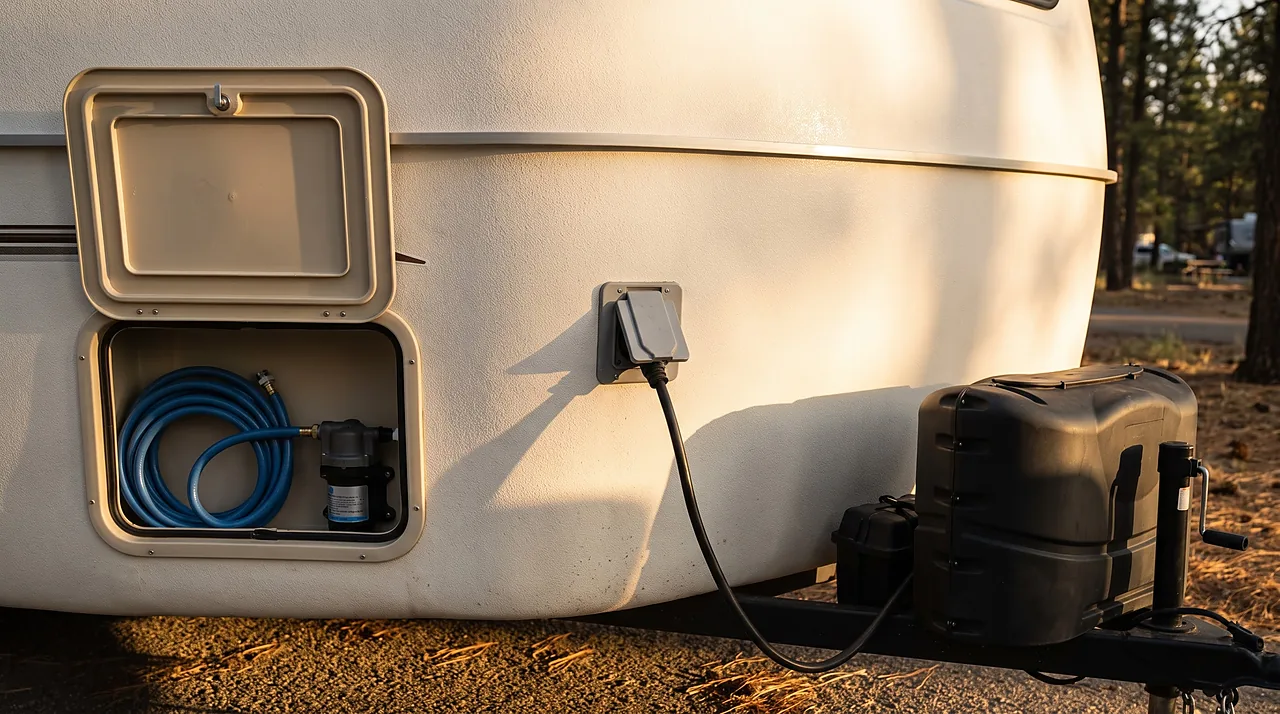
You're standing at the wet bay with a flashlight at nine o'clock, the pump is humming but nothing is coming out of the faucet, and you don't know if the problem is the pump, the water heater, a closed valve, or something electrical. That confusion is normal for a first season, because a travel trailer or fifth wheel is really five separate systems bolted into one box, and most of them share no parts, no wiring, and no failure logic with each other. This page is the map. It tells you which system does what, which one is probably misbehaving based on what you're seeing, and which page on this site has the full fix.
The five systems, in plain terms
Everything onboard sorts into one of five buckets. Knowing the bucket saves you from troubleshooting the wrong thing at eleven at night.
- Fresh water: the pump, the city water connection, the pressure regulator, and everything that delivers drinkable water to a faucet or shower head.
- Waste: the black tank (toilet), the grey tank (sinks and shower), their sensors, and the hose and fittings you use to dump both.
- Electrical: 12-volt house power from the battery and converter, and 120-volt shore power from the 30-amp or 50-amp pedestal, plus the fuse panel and breakers tying them together.
- Propane appliances: the furnace, the water heater's burner, and (on most trailers and fifth wheels) an absorption-style refrigerator that runs on propane or 120-volt power instead of a compressor.
- Roof, slides, and awnings: the membrane and sealant keeping water out, plus the moving hardware that lets a slide-out or awning extend and retract without binding.
A rig that tows or drives itself, its chassis, brakes, hitch, and engine, is a different animal with its own maintenance rhythm entirely. That's outside what this page covers; the five systems above are the ones living inside the walls.
What's going wrong, and which system owns it
Most first-season symptoms point clearly to one system once you know what to look for. Find your symptom below to see which system is responsible and which page walks through the full fix.
Fresh water
- No water at any faucet, even with the pump running: a priming issue, an air lock, or a closed low-point drain. Full walkthrough at the fresh water system.
- Pump chatters or short-cycles with every faucet fully closed: usually a worn pressure switch or a tiny line leak. Details at diagnosing a pump pressure switch.
Waste
- Black tank gauge always reads full, even right after dumping: a sensor fouled with tissue or residue, not a real clog. More at fixing misreading tank sensors.
- Sewer smell drifting into the cabin: usually a dry trap, a bad seal, or a vent issue. More at tracking down RV toilet smell.
Electrical
- Breaker trips the moment the air conditioner and microwave both run: you're pulling more than a 30-amp service can give. More at 30-amp versus 50-amp service.
- House battery is dead by morning even though nothing was left on: a parasitic draw somewhere on the 12-volt side. More at tracking a parasitic battery draw.
Propane appliances
- Furnace blower runs, but it never lights: often a battery too weak to trip the igniter. More at why a furnace won't ignite.
- Fridge stays lukewarm despite running fine on the last trip: usually an unlevel rig or a blocked roof vent. More at fixing a fridge that won't cool.
Roof, slides, and awnings
- Brown ring or soft spot on the ceiling near a corner: a cracked or shrunk sealant bead letting water track inward. More at roof sealant inspection and repair.
- Slide-out grinds, hesitates, or stops partway: usually dry rails, a jammed track, or debris. More at slide-out maintenance.
Fresh water: pressure and the pump
Pressure is where most rookie damage happens, and it happens quietly. Campground pressure can spike well above what RV plumbing is built for. The plumbing itself is generally rated for around 60 psi before fittings and hoses start failing. An inline regulator set to 40-50 psi at the spigot is essential gear, the difference between a quiet week and a split fitting behind a wall you can't see. The pump itself is simpler than it looks: it needs a primed line, a charged battery, and nothing pinching the intake. The full walkthrough on priming, pressure switches, city connection setup, and what a pulsing pump actually means lives at the fresh water system guide.

Waste tanks: the two-thirds rule and plain tank talk
Here's the one rule that prevents most black tank disasters: leave the valve closed while you're camped, even with a full sewer hookup, and dump only once the tank is at least two-thirds full. Thetford is direct about why the closed-valve rule matters: leaving the valve open lets liquid drain off immediately and strands solids in a mound directly under the toilet, a mess nicknamed the "poop pyramid" that sometimes needs a professional to clear. A gauge that reads full a day after dumping is almost always tissue or residue stuck to the sensor plate, so clean the sensors before you assume one has failed. Sensor cleaning, tank treatments that actually work, and the full dump-day sequence are covered start to finish at the full black tank guide.
12-volt and 120-volt: two different animals under one roof
Your house battery runs 12-volt loads (lights, the water pump, the furnace board) through a converter that recharges it whenever you're plugged into shore power. Shore power itself is either 30-amp service, good for about 3,600 watts (120 volts times 30 amps), or 50-amp service, which splits into two 120-volt legs for roughly 12,000 watts total. A converter and an inverter get confused often, and they do separate jobs: a converter turns shore or generator power into DC for the battery, and an inverter makes 120-volt AC from battery power for things like a residential outlet; see how the converter and inverter fit together. Amperage math, dogbone adapters, and why a 30-amp rig trips breakers that a 50-amp rig never would are all broken down at 30-amp versus 50-amp service. A generator or roof solar panels are the other ways power comes in when you are not plugged in; both feed the same 120-volt or 12-volt side, and sizing them is a separate topic.

Propane appliances: furnace, water heater, and the absorption fridge
A furnace that runs its blower but refuses to light is frequently a battery problem wearing a propane costume. The igniter and gas valve need a healthy voltage supply to fire, and a battery sagging under about 10.5 volts can leave the blower spinning with no flame ever appearing.
Water heater maintenance starts with knowing which tank you have, because the rules differ completely by brand. The sacrificial anode rod applies to Suburban water heaters, whose tanks are steel; Atwood and Dometic water heaters use aluminum tanks and do not use an anode rod, so check the brand plate before buying parts or draining the tank. On a Suburban, the rod is built into the drain plug, and a rod worn down to a stub is a cheap swap that heads off a much costlier tank replacement; see checking the anode rod. If the burner refuses to ignite or the water stays cold on both gas and electric, troubleshooting a water heater that won't heat walks through the thermostat, switch, and control board checks.
The absorption refrigerator many trailers carry uses a different cooling method than a home fridge. It circulates ammonia by gravity flow, so it genuinely needs the rig level to cool, and running it noticeably tilted for hours is one of the few things that can quietly damage the cooling unit for good. On a brutally hot afternoon, some loss of cooling is simply this design reaching its physical limit.
Roof, slides, and awnings: the parts that live outside
The roof deserves more attention than it gets, mostly because problems up there stay invisible until water has already found a path inside. Sealant should get a visual check about every six months, and the type matters: Dicor's own product line splits self-leveling formula for flat, horizontal seams from a non-sag formula meant for vertical trim, and using the wrong one on a steep surface means it never sets up correctly. Slide rails and awning hardware need a dry lubricant on the tracks and gears, since a wet spray lubricant collects grit in those same spots. Awning mildew responds well to a mild vinegar solution, a gentler approach than aiming a pressure washer at the seams.

Winterizing and the calendar that ties it all together
Come the first hard freeze, every one of these systems needs a version of the same instruction: get the water out or protect what's left with the right kind of antifreeze. That means propylene glycol, the pink RV and marine formula made for potable systems. Automotive antifreeze, the green kind, is toxic and belongs nowhere near a potable water system. Bypassing the water heater before you pump antifreeze through the lines saves you six to ten gallons of product, depending on whether your tank holds six gallons or ten. The complete seasonal sequence, including the compressed-air blowout method and when to skip antifreeze entirely, is at the winterizing guide, and a season-by-season rundown of every check mentioned on this page, roof, batteries, tank sensors, and all, lives at the RV maintenance checklist.
Just bought it? The first checks on a new-to-you RV
- Roof sealant: look at every seam and corner before the first rain; see roof sealant inspection.
- Water: connect through a pressure regulator set to 40-50 psi and look under sinks and in the wet bay for drips; see hooking up to city water.
- Waste: check that both dump valves open and close fully and the tank sensors read sensibly after a flush; see black tank basics.
- Battery: a lead-acid house battery should not be run below about 50%, and a furnace that won't light is often a weak battery; see why a furnace won't ignite.
- Water heater: find out whether it is a Suburban (anode rod) or an Atwood or Dometic (no rod) before the first drain; see checking the anode rod.
Where to go from here
If you only remember one thing from this page, make it the system map above. Match what you're seeing to a system, follow that link, and fix the actual problem in front of you.
Questions
What owners ask next
Do I need to understand all five systems before my first trip?
No. Learn the water pressure regulator and the black tank valve rule first, since those two cause the most avoidable damage and mess for new owners. The electrical and propane sections matter more once you're dry camping or facing your first cold night.
My rig has a compressor fridge instead of a propane one. Does the leveling rule still apply?
No. Residential-style compressor fridges cool the same way a home refrigerator does and don't depend on gravity-fed ammonia flow, so being slightly off level won't hurt them the way it can an absorption unit.
Is there one tool that covers pressure, tank levels, and battery voltage at once?
Not really, and be wary of anything claiming to. A pressure regulator, a tank sensor reader or simple tap test, and a basic multimeter are three separate, inexpensive tools, each suited to one system.
Read next
Keep going on this system
Sources
What this guide is based on
- Camco
- Suburban Manufacturing
- Dicor Products
- Thetford
Built from manufacturer manuals and published specifications. If something here does not match your appliance label or manual, the label and manual win.